The First-Generation NSX Is the GOAT

The 1990 Honda NSX changed what a supercar could be. Here's how it holds up across engineering, driving feel, and long-term value.
Few cars in the past four decades forced an entire industry to reconsider its assumptions the way the first-generation Honda NSX did. When it arrived in 1990, it exposed Ferrari's reliability problems and ergonomic compromises so thoroughly that General Motors purchased one of the first examples to reach the United States in order to study its engineering. Gordon Murray called the car remarkable and used its ride quality and handling as his design targets for the McLaren F1. Those are not small endorsements.
This is a piece about the first generation -- the NA1 and NA2, 1990 through 2005 -- because that is the car that changed things. Six reader questions about its history, engineering, and legacy all point the same direction, so that is the direction we are going.
Historical Context: Disrupting the Italian Establishment
In the late 1980s, the supercar market was effectively owned by three European countries. Ferrari ruled with the 328 and 348, Porsche anchored the segment with the 911, and Lamborghini offered the Countach. These cars were desirable partly because they were difficult -- loud, temperamental, expensive to maintain, and demanding to drive. Honda saw an opening.
The NSX project was preceded by the HP-X concept, designed by Pininfarina, with a straightforward mission: match or exceed the performance of Ferrari's V8 sports cars, undercut them on price, and make the result usable every day. The car that launched in 1990 -- sold as an Acura in North America -- delivered on all three counts. It featured a mid-engine layout, an all-aluminum chassis, and development input from Formula One World Champion Ayrton Senna.
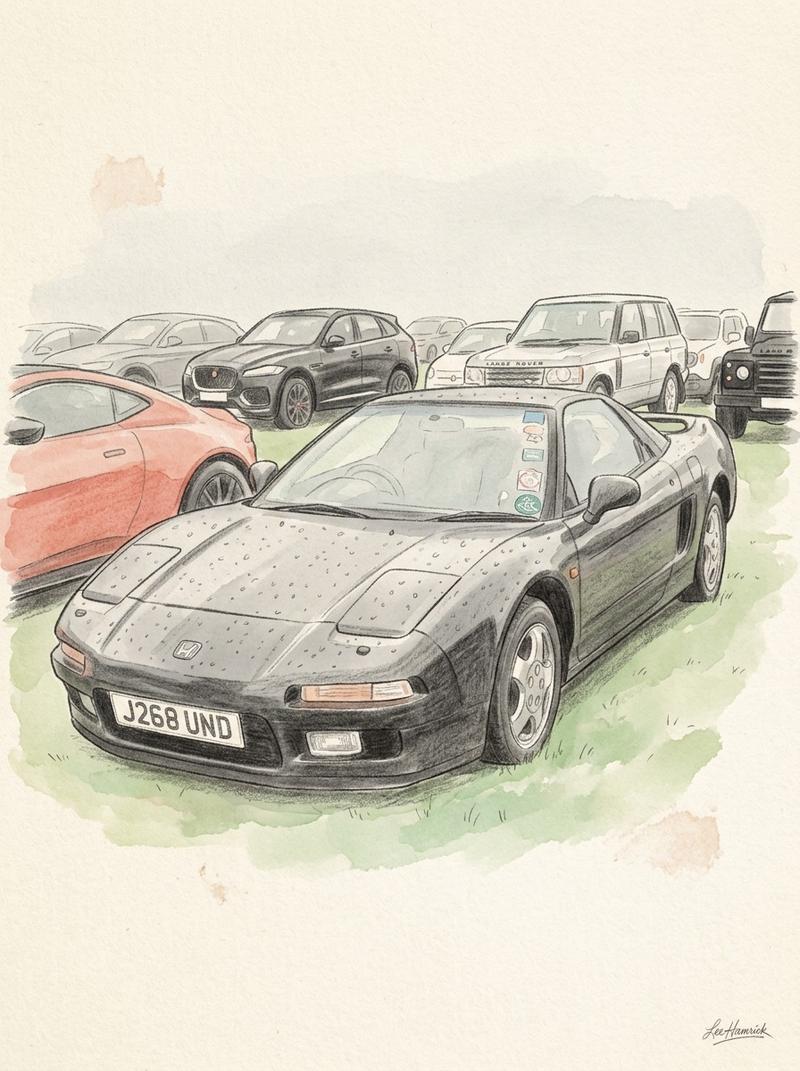
The industry reaction was immediate and documented. The NSX embarrassed the 348 badly enough that Ferrari's reliability problems and ergonomic compromises became impossible to ignore. The F355, launched in 1994, arrived with significantly improved handling and refinement over the 348, and the NSX is widely cited as the competitive pressure that made those shortcomings untenable. No authoritative source records Ferrari engineers directly attributing the F355's specific improvements to NSX blueprints -- the framing is that the NSX forced Ferrari to respond, which is a different and arguably more significant thing. Gordon Murray's endorsement went further: he used the NSX's ride quality and handling as his explicit design targets for the McLaren F1, calling the car remarkable.
Ayrton Senna's Involvement
Senna's name is attached to the NSX in a way that tends to get vague in the retelling, so here is what is documented. During prototype testing, Senna pushed Honda's engineers to stiffen the chassis by 50 percent. That figure comes from Honda's own development record. The practical result was a structure rigid enough that the suspension could be tuned for simultaneous precision and compliance -- two things that usually trade against each other. Early NSXs had no power steering, and Senna's chassis stiffening is part of why that worked: a car with a flexy structure and no power steering would have been exhausting. The NSX was not.
What Senna's specific testing protocol looked like -- which circuits, how many sessions, what instrumentation Honda used -- is not something the available record answers in detail. What the record does answer is that his intervention was structural and that the number is 50 percent.
Engineering and Technology: A Collection of Firsts
The 1990 NSX arrived as a collection of genuine firsts. Honda's own heritage documentation confirms it was the world's first production car with an all-aluminum semi-monocoque body. The aluminum saved nearly 200 kg over steel in the body structure alone, with an additional roughly 20 kg saved separately through aluminum suspension arms. Those are two different numbers for two different things, and conflating them into a single figure understates what Honda actually accomplished.
The engine used the first production titanium connecting rods, which is what enabled a reliable 8,300 rpm redline from a road car. From 1995, the NSX gained the first electronic throttle fitted to a Honda production car. The braking system used 4-channel ABS when that technology was still exotic on road cars. Honda applied a 23-step paint process derived from aircraft finishing to ensure the aluminum panels had a flawless surface. The engineering philosophy was consistent throughout: take racing materials and make them last in everyday use.
Performance Specifications
The original 1991 NSX used a 3.0-liter DOHC V6 producing 270 hp and 210 lb-ft of torque. In standard manual-transmission form it reached 60 mph in approximately 5.2 seconds and topped out between 168 and 175 mph. A 4-speed automatic was available but detuned to 252 hp. In 1997 a larger 3.2-liter V6 replaced the original unit, pushing output to 290 hp and 224 lb-ft and pairing with a new 6-speed manual. Car and Driver recorded 0-60 mph in approximately 4.5 seconds with that combination.
The car weighed around 1,370 kg in early form. That number matters more than the horsepower figure. A drag coefficient of 0.32, combined with balanced chassis dynamics and that weight meant the NSX could match heavier, more powerful cars on a twisty road in ways that dyno sheets did not explain.
Driving Experience: Analog Precision
The original NSX earned its reputation through balance rather than brute force. Its aluminum semi-monocoque, fully independent double-wishbone suspension, and rear-mid engine placement produced near-neutral weight distribution and sharp responses. Senna's chassis stiffening was not cosmetic. It is what allowed the suspension tuning to work.
No power steering on early cars. Combined with the car's low mass and well-resolved geometry, that produced steering feel that contemporary reviewers consistently singled out. The car's behavior at the limit was deliberately approachable -- it would push into gentle understeer before a driver reached the edge rather than snapping into oversteer. Reviewers in the early 1990s noted that it rewarded novice drivers without boring experts. Honda equipped it with 4-channel ABS, but electronic intervention was otherwise minimal. This was a largely mechanical experience, and that is the point.
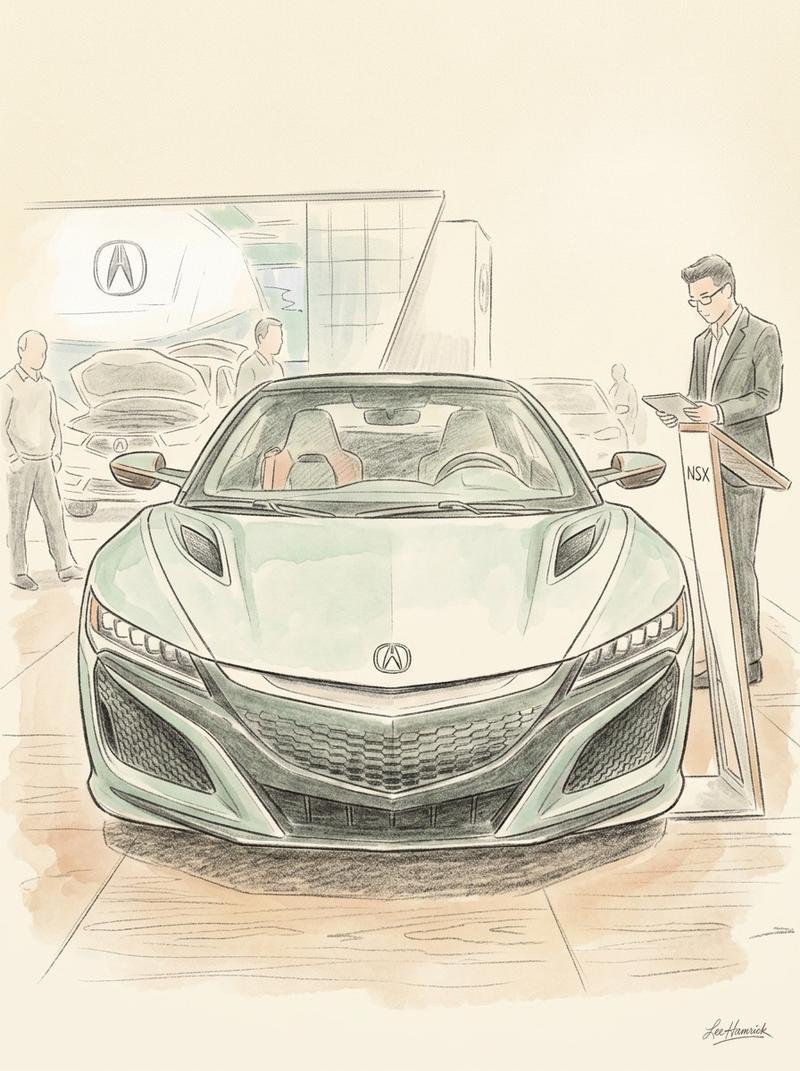
Road and Track called it the best sports car Japan had ever produced. Murray's benchmark claim was specific: ride quality and handling, not just outright grip. The NSX was not the fastest car you could buy in 1990. It was the most resolved.
What Contemporary Reviews Actually Found
Beyond Road and Track's summary verdict, reviewers in the early 1990s identified consistent themes. The ergonomics were a direct contrast to the Ferrari 348: good outward visibility, a driver-centric but livable interior, and controls that did not punish you for not being an expert. The 348's interior was cramped and ran hot; the NSX was neither. Reliability in period testing was not a long-term study but a directional observation -- owners reported minimal maintenance issues across high mileage in ways that were simply not possible to say about Italian alternatives of the same era.
Specific long-term owner-reported maintenance records across the full 15-year production run are not something a single source consolidates cleanly. What is documented is that the NSX owner community (NSX Club of America, NSX Prime) has kept parts and knowledge accessible for decades, which is its own reliability signal. A car with fragile long-term ownership tends not to generate active communities 30 years later.
Production Numbers and Market Reception
Over 15 years, approximately 18,000 NSXs were built worldwide, with around 8,949 sold in the United States and Canada combined. Early demand in 1991 and 1992 generated waiting lists and dealer markups. By the late 1990s, competitors had surpassed the NSX's power output: the Ferrari 360 Modena made 400 hp, the Chevrolet Corvette Z06 made 405 hp, and the NSX's 290 hp maximum looked modest in a spec-sheet comparison. A strong yen made production expensive, and Honda chose not to invest in a significant powertrain update. When production ended in 2005, the NSX had never been a profit center. It had permanently elevated Honda's reputation as a maker of world-class performance cars.
Design
Chief Designer Masahito Nakano drew inspiration from an F-16 fighter jet cockpit. The result was a low, wide car with a teardrop cabin and exceptional outward visibility -- deliberately unlike the claustrophobic interiors of Italian rivals. Pop-up headlights, smooth door intakes, and a full-width rear light bar gave the original NSX a distinctive identity without aggression. Its drag coefficient of 0.32 was achieved through surface management rather than wings and vents.
The design changed little in 15 years. The 2002 refresh replaced pop-up headlights with fixed xenon projectors and revised the nose and tail slightly. A 1995 addition -- the NSX-T Targa top -- offered open-air driving without compromising the coupe's structure. Placed next to a contemporary Ferrari 348, most observers consider the NSX the more resolved design. It remains clean and proportionate now.
Collectability: A Confirmed Blue-Chip Classic
The original NSX has completed its transformation from depreciated used car to sought-after classic. In the late 2000s, examples could be purchased for $30,000 to $40,000. Average sale prices today have risen to approximately $120,000, and rare variants command more.
The most coveted examples are the Japan-only Type R and NSX-R models. The NA1 Type R (1992), of which 483 were built, and the NA2 NSX-R (2002), of which 140 were produced, represent the hardcore end of the range. The auction record was set in August 2023 when a 1995 NSX Type R sold for $632,000. In the United States, the 1999 Alex Zanardi Edition -- 51 cars built as a tribute to the CART champion, with weight reductions and special trim -- is similarly prized. Standard cars in good condition, particularly early examples or the final 2005 production cars, regularly reach six figures.
The collectability rests on several pillars: pioneering aluminum construction, Senna's documented development involvement, Honda's reputation for mechanical longevity, and an active owner community that keeps parts and knowledge accessible. These factors make the first-generation NSX a more practical classic than many contemporaries from Maranello. Values are expected to continue rising, particularly for low-mileage, unmodified examples.
The 1995 NSX Type R sold for $632,000. The car it sold for that much debuted at $62,000 in 1991. That is the resume.

Written by
Lee Hamrick