Want to start doing track days? Miata Is Always The Answer
When exploring the world of motorsports, the quest to find the ideal…
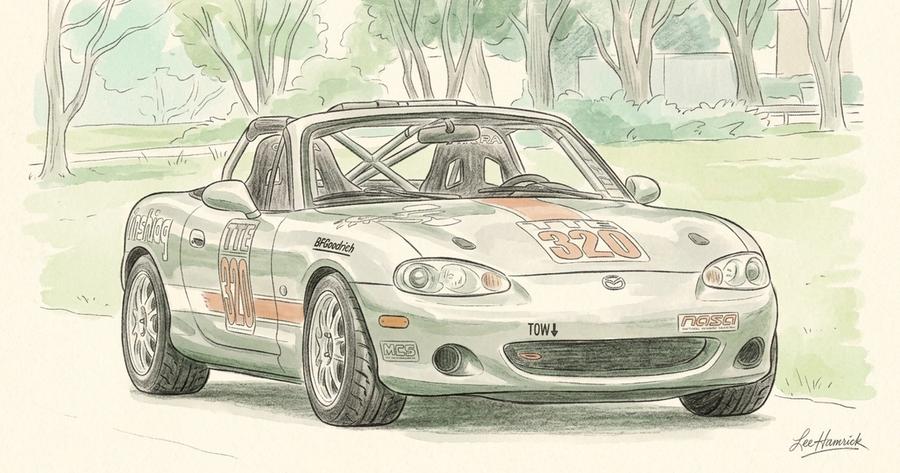
If you've decided to stop watching motorsport and start doing it, one question comes up immediately: what car do you bring? You could spend months agonising over used BMWs, Honda Civics, and Subaru WRXs — or you could listen to the advice that's been echoing through paddocks for decades. The Mazda Miata is always the answer. Here's why it keeps earning that reputation, and what you actually get when you show up at your first track day in one.
The Price of Entry Is Genuinely Low
Mazda Miatas are among the cheapest ways into wheel-to-wheel or open-latch track days, both at purchase and on an ongoing basis. A clean NA (1989–1997) or NB (1998–2005) can be sourced for anywhere between $4,000 and $10,000 depending on condition and mileage. The NB in particular is respected for its torsional rigidity improvements over the NA and its smooth 1.8-litre engine.
Running costs stay manageable because the parts supply is enormous. Miata-specific suppliers like Racing Beat and Flyin' Miata have been stocking components for over thirty years, and the car shares enough common hardware with mainstream Mazda parts bins that a blown wheel bearing or worn brake pad is never a crisis. For a beginner building a budget track car, the difference between a parts-rich platform and an obscure one is the difference between racing next weekend and waiting six weeks for a shipped component.
Lightweight Engineering That Teaches You to Drive
The NA Miata weighs around 960 kg. That's not a coincidence — it's a design philosophy. Mazda's engineers, inspired openly by the Lotus Elan, built a car where mechanical grip and chassis balance do the communicating. There's no heavy front-engine, front-wheel-drive understeer to mask your mistakes, and no excessive power to paper over bad lines.
What you get instead is a car that responds immediately and honestly to every input: steering angle, throttle timing, braking point. The classic front-engine, rear-wheel-drive, near-50/50 weight distribution layout means that weight transfers predictably when you brake into a corner and when you get back on the throttle. For a new track driver trying to understand what oversteer feels like, or how to manage a car at the limit without spinning it, the Miata is about the safest classroom available. You'll feel the rear beginning to step out well before it becomes unrecoverable.
Reliability That Lets You Focus on Driving
Track driving is hard on machinery. Brake temperatures climb, coolant temperatures spike, and components that were perfectly happy on the street start to show their true character. The Miata's 1.6 and 1.8 BP-series four-cylinder engines are well-documented in terms of their heat management and failure modes. They don't run hot easily, they don't surprise you with catastrophic failures if maintained properly, and a cam seal or water pump job is afternoon work with basic tools.
This matters enormously when you're starting out. The last thing a new track driver needs is a car that demands mechanical attention between sessions. The Miata lets you concentrate on laps.
Feedback You Can Actually Learn From
Seasoned instructors repeatedly put beginners in the Miata because it provides direct, unfiltered feedback through the steering wheel, seat, and pedals. There's no electric power steering blunting the road feel, and the suspension geometry is communicative enough that you feel the grip limit approaching rather than suddenly exceeding it.
This is what "driver's car" actually means in practical terms. The Miata doesn't isolate you from the physics — it involves you in them. That involvement is exactly what accelerates driver development.
A Community That's Already Done the Work for You
The Miata community is one of the most resource-rich in amateur motorsport. Clubs like the Miata Club of America have been running events and compiling technical knowledge since the early 1990s. Online forums, local club days, and dedicated Facebook groups mean that whatever question you have — which brake pads, which alignment spec, which rollbar — someone has already tested it and written it up.
For a first-time track driver who doesn't yet know what they don't know, this collective knowledge is genuinely valuable.
A Platform You Can Grow With
When you're ready to start modifying, the Miata accommodates nearly every level of commitment. A basic track setup might mean stiffer springs, fresh brake fluid, and a set of sticky tyres. Beyond that, a full Flyin' Miata V8 conversion represents the other end of the spectrum. Most drivers find themselves somewhere in between: adjustable coilovers, a limited-slip differential, upgraded brake pads and rotors, and a hardtop for safety compliance. Each modification teaches you something about how the car behaves, which in turn teaches you more about driving.
Key Takeaways
- Low buy-in cost: Clean NA and NB Miatas are available from around $4,000–$10,000, with a deep, affordable parts supply from long-established suppliers.
- Built for learning: The near-50/50 weight distribution and ~960 kg kerb weight produce honest, readable feedback that teaches correct technique rather than hiding mistakes.
- Proven reliability: The BP-series engine is well-understood and durable under track conditions, keeping mechanical surprises to a minimum.
- Exceptional community support: Decades of club racing and forum documentation mean answers to almost every question are already documented and freely shared.
- Room to grow: The platform supports modifications from basic safety and handling upgrades all the way to engine swaps, so the car can keep pace with your development as a driver.

Written by
Anna Buchanan