M140i vs Kona N: What a Track Day Actually Reveals About Budget Performance

BMW M140i and Hyundai Kona N tested on track. RWD straight-six against FWD turbo hot SUV: which daily driver is actually faster?
The moment you line up a BMW M140i and a Hyundai Kona N at a circuit, you're looking at everything wrong with how we talk about performance cars. One is a compact sedan with a 3.0-liter straight-six and rear-wheel drive. The other is a turbocharged hot SUV wearing a tall stance and more body roll than any enthusiast would willingly accept. On paper, the gap reads like a half-decade of engineering philosophy. On track, it closes faster than the spreadsheet suggests.
The Setup That Actually Matters
A stock M140i runs 340 horsepower through a six-speed manual or eight-speed automatic. The numbers have aged into the low end of modern performance; BMW made this engine in 2011, and even with the F20 refresh, it feels like a car that predates the turbo-everything era. The Kona N, by contrast, is a creature of 2021 thinking: 302 horsepower from 2.0 liters of turbo, eight-speed DCT, and an available electronic limited-slip differential that Hyundai actually engineered to work on the road, not just sign off on.
The M140i we're comparing here isn't stock. A reasonable tune (intake, exhaust, ECU) pushes it toward 370-385 horsepower depending on octane. That's the real-world move if you own one and care about performance; BMW knew the engine had headroom, and the tuning community proved it two decades ago. The Kona N, meanwhile, respects its power delivery enough that it doesn't need the same aftermarket assistance. Hyundai's engineers actually dialed in what they sold you.

Handling Reveals the Difference That Numbers Hide
Here's where the track day actually teaches you something, because horsepower tells you almost nothing about which car makes a driver feel better on a road course.
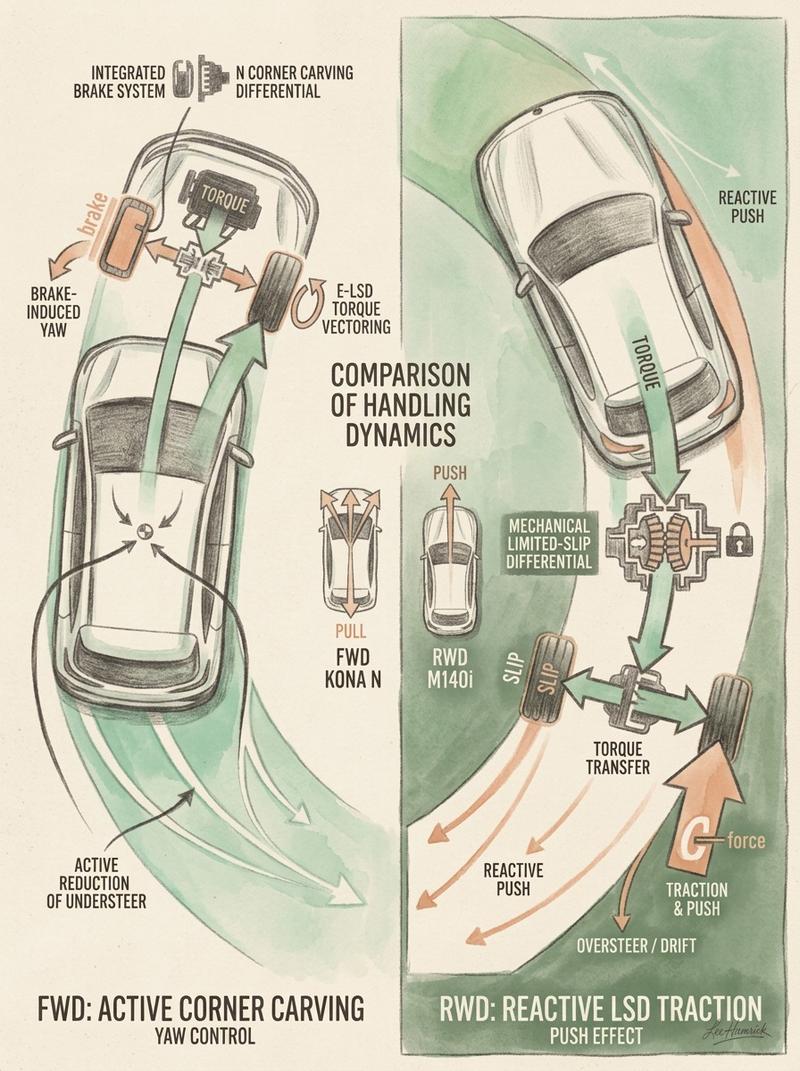
The M140i is rear-wheel drive with an LSD standard on manual cars. Its balance point lives in a familiar place: you can load the front, trail-brake into a corner, and feel the rear axle waiting to slide if you ask it to. This is what thousands of track day drivers have been finding in 1-series and 3-series cars since 2011. It's narrow enough that brake balance feels intuitive, direct enough that you trust what the tires are telling you. The steering ratio is quick without being nervous. Everything whispers about being driven hard rather than screaming about it.
The Kona N is front-wheel-drive with a torque-vectoring differential that actively brake-applies the inside rear wheel during corners. This does something counterintuitive: it makes a front-driver feel more willing to be pointed at apexes than you'd expect from the layout alone. Hyundai's engineers tuned it so that the brake application feels like a subtle nudge toward neutral, not a correction. On a tight circuit, this changes your reference point. You stop being afraid of understeer and start being afraid of being imprecise with brake timing, which is actually faster.
The trade-off is body roll. The Kona N's suspension is firmer than a typical SUV, but it's still an SUV. Turn-in feel is delayed by a half-meter of sidewall and more vertical mass than the M140i carries. You feel the thing settling into a corner rather than already being there. This doesn't make it slow; it makes it different. Most drivers would be quicker in the M140i on their first lap. After ten laps, the gap shrinks because the Kona N's chassis compliance actually helps you keep traction under imprecision.
Straight-Line Speed Isn't the Whole Picture
The M140i's 0-60 advantage (mid-5 seconds for the tuned version versus mid-6 for the Kona N) matters only on the straights, where it matters a lot. A two-liter turbo will never spool as linearly as a naturally aspirated 3.0, so in-gear acceleration feels different even if the number on a dyno is close. The M140i pulls smoothly from 2,000 rpm. The Kona N's turbo lag (minimal, but present below 3,000 rpm) means you're learning to heel-toe differently, planning your downshift timing around when boost arrives rather than just engine speed.
Track day reality: the M140i will gap the Kona N on any straight longer than 200 meters. The Kona N will either match it or beat it through any sequence of turns tighter than the distance it takes to reach fourth gear. On a balanced circuit, the question isn't which engine is stronger; it's which driver flows better with the cornering setup.
Braking Separates the Field
Both cars have adequate brakes. The M140i feels more compact under braking, the pedal response more locked-in to what you're trying to do. The Kona N's brake system has to slow more mass, and despite being genuinely capable, there's a threshold of aggression beyond which the Kona N feels like it's working harder. This isn't a weakness; it's geometry. A 3,600-pound sport sedan will always feel more responsive under deceleration than a 3,800-pound hot SUV, even with equivalent pad compound and rotor size.
The real difference emerges in back-to-back lap work. After four solid laps, the M140i's brakes still feel sharp. The Kona N's still work, but you're managing the brake temperature psychology differently. If the track day runs long, the M140i's lighter unsprung mass means it recovers faster between sessions. The Kona N will need a longer cool-down, though Hyundai's cooling system is actually competent.
The Uncomfortable Truth About Driver Input
Most comparisons collapse into specs and lap times. The real finding is stranger: which car makes you faster depends entirely on what you're calibrated for. A driver who learned on RWD Miatas will be quicker in the M140i almost immediately. A driver who grew up in FWD hot hatches will be faster in the Kona N from the first lap. The gap is 2-4 seconds per lap on a typical club circuit, and it's almost entirely determined by where your reference point lives.
The M140i is the more honest driver's car. It tells you what's happening, doesn't hide anything, and rewards smooth inputs. It's also older, so it demands more from you. The Kona N is more forgiving of imprecision and more willing to work with you if you're learning as you go. It's also faster out of the box if you're already competent, because the torque vectoring actually works and the suspension compliance eliminates one class of error.
The Actual Question
This isn't really about which car is faster in the abstract. It's about which one teaches you something on a track day without punishing you for learning. The M140i will get you to the limit faster; the Kona N will let you feel less afraid of the limit while you're learning it. Both are genuinely quick, and both will embarrass a lot of expensive cars if driven properly. The M140i costs less. The Kona N costs less to maintain and comes with a warranty that actually covers performance driving if you read the small print carefully.
There is no wrong answer here. There's only the answer that matches how you think about what fast actually means.