Pump Prices 2026-2027: Why the Rest of the Country Gets Relief While California Pays More
EIA forecasts lower U.S. gas prices in 2026-2027, but two California refinery closures are keeping pump prices near $6 and rising. Here's why and what could cha
The National Picture: Prices Easing Through 2027
Brent crude averaged $69 per barrel in 2025. The EIA's February 2026 Short-Term Energy Outlook forecasts it falling to $58 per barrel in 2026 and $53 per barrel in 2027, as resumption of Strait of Hormuz flows works through global supply. That decline is real, but the starting point is still well above pre-conflict norms, and the path down is uneven by quarter.
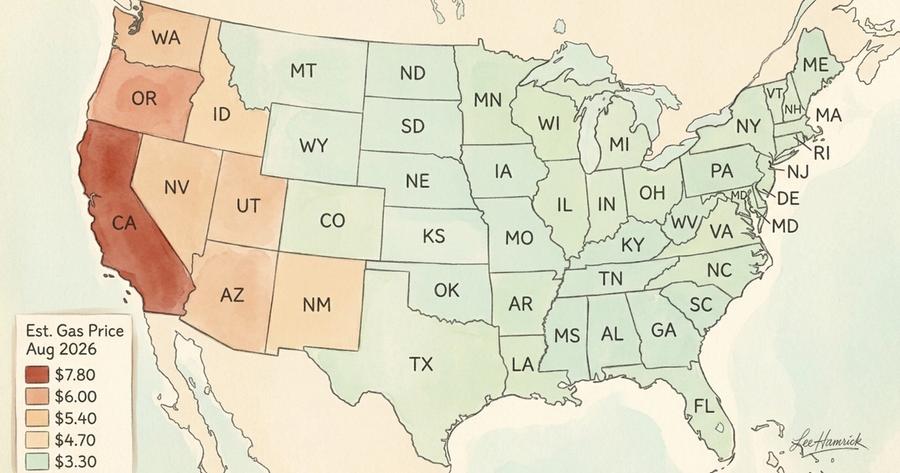
For U.S. drivers broadly, the EIA projects retail gasoline prices falling about 6% in 2026 compared to 2025, then nudging back up 1% in 2027. Both years remain above 2025 in absolute terms on the West Coast. The Gulf Coast holds the lowest prices in the country through the forecast period. The West Coast holds the highest, as it typically does. For most of the country, cheaper fill-ups are a reasonable expectation. California is a different calculation entirely.
Why California Pays More: Three Compounding Problems
1. The Refinery Capacity Collapse
The single biggest driver of California's current price crisis is a rapid loss of in-state refining capacity. Phillips 66 closed its Wilmington plant, rated at 139,000 barrels per day, in late 2025. Valero followed by shutting its Benicia refinery in April 2026. The EIA and California Energy Commission cite Benicia's crude distillation capacity at 145,000 barrels per day; Valero's own published figures put throughput capacity at 170,000 barrels per day. The difference matters for the math, and neither figure has been authoritatively resolved. What is not in dispute: both plants are gone.
Using the lower EIA/CEC figure, the two closures together removed roughly 284,000 barrels per day from a California refining base the EIA puts at approximately 1.6 million barrels per day before the closures, somewhere in the 17-18% range. The EIA itself notes that decreasing U.S. refinery capacity in 2026 may offset some of the downward crude price effect on gasoline, especially in the West Coast region. That is a careful way of saying California drivers will not see the same relief as the rest of the country.
In May 2026, the California average retail gasoline price was $5.95 per gallon, according to the California Energy Commission.
2. A Fuel Market Cut Off From the Rest of the Country
California requires a proprietary low-emission gasoline blend mandated by the California Air Resources Board (CARB). No pipeline connects California to the Gulf Coast or Midwest refineries that supply the rest of the country, and most of those facilities cannot produce CARB-compliant fuel anyway. That leaves California dependent on in-state refining, plus tanker shipments from Asia and a small number of other international facilities capable of meeting the state's specifications. Shipping costs and port delays become embedded in the retail price in ways that simply do not apply elsewhere in the U.S.
3. State Taxes and Environmental Program Costs
The state excise tax sits at 61.2 cents per gallon. The federal excise tax adds 18.4 cents. A state underground storage tank fee adds another 2.0 cents. On top of those fixed charges: as of January 2026, the Low Carbon Fuel Standard adds about 17 cents per gallon (roughly 4% of the retail price), and the cap-and-trade program adds about 25 cents per gallon (roughly 6%). Combined, those two environmental programs account for approximately 42 cents per gallon at current program levels.
Over the previous ten years, crude oil accounted for slightly more than half of the average retail gasoline price nationally. The EIA projects crude's share falling below 45% in 2026 and 2027 as oil prices drop, which means refining costs, taxes, and compliance charges make up a growing fraction of what you pay at the pump. In California, that fraction was already larger than anywhere else in the country.
The projected outcome under current conditions: California pump prices remain elevated well above the national average through the remainder of 2026, with the supply gap from the refinery closures the primary variable. A crude oil spike or another supply disruption would widen that gap further.
For more context on how fuel legislation shapes prices at the pump, see our coverage of California AB 2046.
Four Policy Changes That Could Ease the Pressure
Several targeted adjustments could meaningfully lower pump prices without dismantling California's long-term environmental framework.
Temporary Regulatory Relief During Supply Shortages
The state could suspend portions of the LCFS and cap-and-trade costs during verified supply shortages, with clear expiration dates built in from the start. The LCFS and cap-and-trade programs together currently add about 42 cents per gallon. Even a partial rollback during a supply emergency would deliver direct savings to drivers, with the consumer benefit substantially exceeding the state's short-term program revenue loss.
Refinery Modernization Incentives
A targeted investment over three to five years in tax credits, grants, and streamlined permitting could help keep the remaining California refineries operational and efficient. Maintaining meaningful additional in-state capacity would reduce the supply-shock exposure the Wilmington and Benicia closures have made acute. The specific cost and savings figures require more detailed modeling than is publicly available right now, but the direction of the trade-off is straightforward: less domestic capacity means greater import dependence and larger price swings.
Faster Import Permitting and Strategic Fuel Storage
Accelerated permitting for CARB-compliant fuel imports, combined with expanded fuel storage infrastructure, would reduce the price spikes that arrive with port delays and seasonal demand surges. California's physical isolation from the Gulf Coast pipeline network means every supply disruption hits harder and lasts longer than it would in a connected market. A modest strategic reserve would recoup its cost by flattening the concentrated price pain California drivers absorb during summer peaks or global supply disruptions.
Cost-Benefit Review of New CARB Rules
Any upcoming CARB regulation with a direct effect on fuel supply should clear a transparent cost-benefit test before adoption. Rules that tighten supply without proportional environmental returns compound the problem the Wilmington and Benicia closures have already created. Built-in review timelines and measurable performance targets would keep new regulations accountable without reversing California's broader clean air commitments.
[IMAGE_3]
What California Drivers Can Do Right Now
California drivers have direct channels to the officials and agencies making these decisions. Enough constituent contact on a specific issue moves the needle.
Contact Governor Gavin Newsom
- Phone: (916) 445-2841
- Online form: https://gov.ca.gov/contact/
- Mail: Office of the Governor, 1021 O Street, Suite 9000, Sacramento, CA 95814
Ask specifically for temporary LCFS and cap-and-trade relief tied to the refinery closures, plus a refinery modernization incentive package.
Contact Your State Assemblymember and State Senator
Find both representatives in seconds at https://findyourrep.legislature.ca.gov/ by entering your address. Members of the Assembly Utilities and Energy Committee and the Senate Energy, Utilities and Communications Committee are particularly relevant. Reference the refinery closures and the four policy options above when you call or write.
Submit Public Comments to CARB
CARB accepts public comments on upcoming LCFS and cap-and-trade rule changes at https://ww2.arb.ca.gov/applications/public-comments, by email at [email protected], or by phone at (916) 322-5594. Keep comments brief: identify the refinery closures, cite the current price data, and request cost-benefit requirements plus temporary supply-shortage relief.
Sample Letter (Copy, Fill In, and Send)
Subject: Support Targeted Relief on LCFS/Cap-and-Trade and Refinery Incentives to Lower Gas Prices
Dear Governor Newsom / Assemblymember [Name] / Senator [Name],
As a California driver, I am concerned about the impact of the Wilmington and Benicia refinery closures on pump prices. California's average retail price reached $5.95 per gallon in May 2026, according to the California Energy Commission, while the national average remains well below $4.00. These closures, combined with CARB fuel specifications and LCFS/cap-and-trade compliance costs currently adding about 42 cents per gallon, are driving California prices significantly above the national average.
I respectfully ask you to support:
- Temporary, time-limited relief from portions of LCFS and cap-and-trade rules during verified supply shortages
- Targeted incentives to modernize remaining in-state refineries and maintain domestic capacity
- Faster permitting for CARB-compliant imports and expanded fuel storage capacity
These steps would deliver real relief at the pump while keeping long-term environmental goals intact. Thank you for your attention to this issue.
Sincerely,
[Your Full Name]
[Your Address]
[Your Phone and Email]
Key Takeaways
- The EIA forecasts U.S. retail gasoline prices falling about 6% in 2026 versus 2025, then up 1% in 2027. The West Coast is expected to track roughly equal to 2025 in 2027, not declining with the national average. California's May 2026 average was $5.95 per gallon, according to the California Energy Commission.
- Phillips 66 closed its Wilmington plant (139,000 bpd) in late 2025. Valero shut its Benicia refinery in April 2026; capacity figures vary by source between 145,000 and 170,000 bpd. Together the closures removed roughly 17-18% of California's pre-closure refining base using the lower EIA/CEC figure.
- California's CARB-mandated fuel blend, absence of pipeline connections to lower-cost refining regions, 61.2 cents per gallon state excise tax, and LCFS/cap-and-trade costs adding about 42 cents per gallon together account for a significantly larger share of the retail price than in any other region of the country.
- The EIA notes explicitly that decreasing U.S. refinery capacity in 2026 may offset some effects of lower crude oil prices on gasoline, especially in the West Coast region.
- Four targeted, time-limited policy changes, temporary regulatory relief, refinery modernization incentives, faster import permitting, and CARB cost-benefit reviews, represent the practical levers available to California policymakers right now.

Written by
Lee Hamrick