10 Hero Cars of Group B Rallying

The FIA's Group B era lasted four years and produced some of the most extreme rally cars ever built. Here are ten that defined it.
The minimum production requirement was 200 units. That number, set by the FIA when they introduced Group B regulations in 1982, was the door they left open, and manufacturers kicked it off its hinges. What followed was four years of the most technically unhinged, visually wild, and ultimately dangerous motorsport the world had ever permitted. Turbocharged. Four-wheel drive. Composite construction. Spectators standing close enough to feel the air move.
It ended the way things built to extremes tend to end. Henri Toivonen and co-driver Sergio Cresto were killed on the 1986 Tour de Corse when their Lancia Delta S4 left the road completely and went down a mountainside. The cause was never officially confirmed, though investigators examined suspension failure and fire among the leading theories. The FIA banned Group B from the World Rally Championship at the end of that season, and that was that. Four years. Gone.
But the cars stayed. They stayed in the record books, in the archive footage where you watch and genuinely cannot believe it was allowed, and in the memories of everyone who saw them run. These are ten of the ones that mattered most, including a couple that never got the chance to prove what they were.
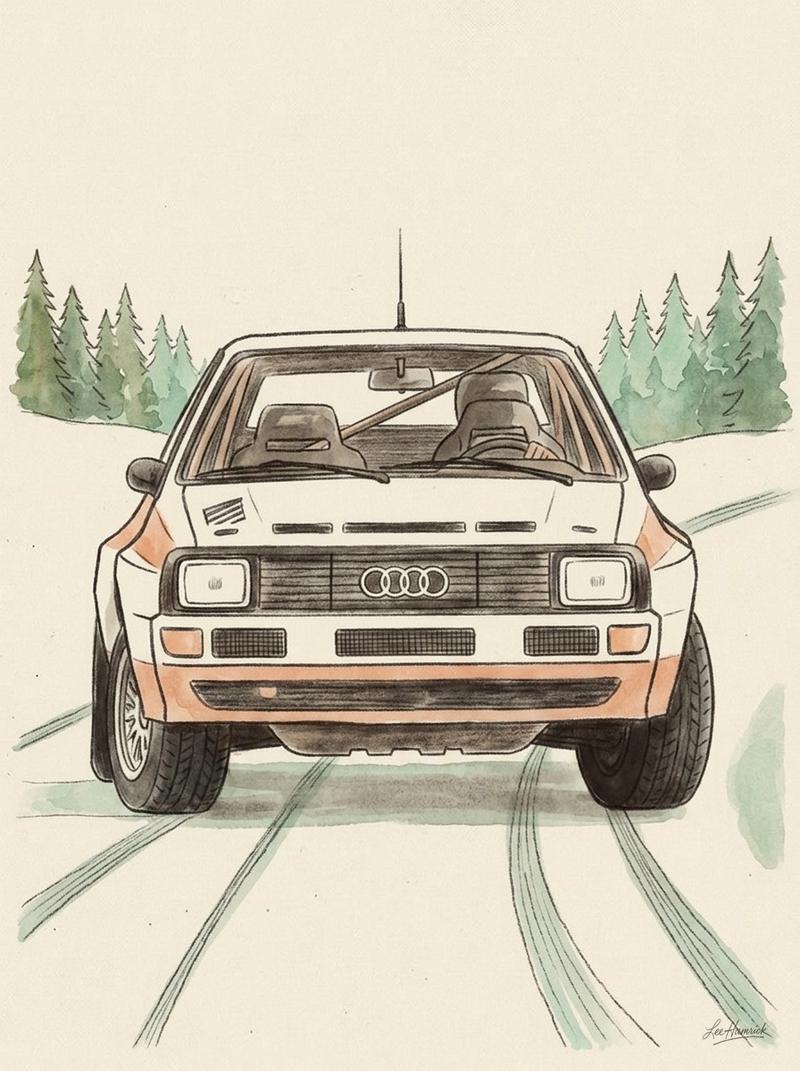
Audi Sport Quattro
The Sport Quattro arrived before anyone else had figured out what Group B actually permitted, and Audi used that window to rewrite the sport's basic assumptions. Four-wheel drive and turbocharging, combined in a short-wheelbase package built around a 2,133 cc five-cylinder engine, produced something the competition couldn't immediately answer. They won. They kept developing. And every AWD rally car that came after them owes something to what Audi proved in those early seasons. The boxy silhouette looks dated now and somehow still right.
Lancia 037 Rallye
The 037 won the manufacturers' championship in 1983, which is worth sitting with for a moment: the last rear-wheel-drive car to win the World Rally Championship. Built around the center tub of the Lancia Beta Montecarlo, with tubular subframes front and rear, supercharged rather than turbocharged, and light enough to exploit tarmac stages where grip mattered more than raw horsepower. The Quattro had AWD. The 037 had balance and a body shape that still stops people cold in photographs. It beat the Quattro anyway, once, and then the AWD cars caught up and the era moved on without it.
Peugeot 205 T16
From the outside it looked like the front-drive hatchback sitting in a supermarket parking lot in 1985. Under the skin it was unrelated to that car in almost every meaningful way: mid-engine, turbocharged, four-wheel drive. The Evolution 2 competition version produced over 500 horsepower in a car that weighed close to nothing. Peugeot won back-to-back manufacturers' titles in 1985 and 1986. The 205 T16 is probably the definitive Group B car if you had to pick one, the machine that most completely represented what the regulations made possible while still wearing a recognizable face.
MG Metro 6R4
Everything about the 6R4 was a contrarian choice. Naturally aspirated in a field of turbocharged cars, all-wheel drive, wearing Metro bodywork over a purpose-built chassis. No boost curve to manage, no lag to time around. The power was always there, which made it predictable in the way only naturally aspirated engines are predictable, and on loose forest stages where traction management mattered more than peak numbers, it was quick. It never threatened for the championship. It was a forest specialist with a grocery-getter face, and that combination made people love it.
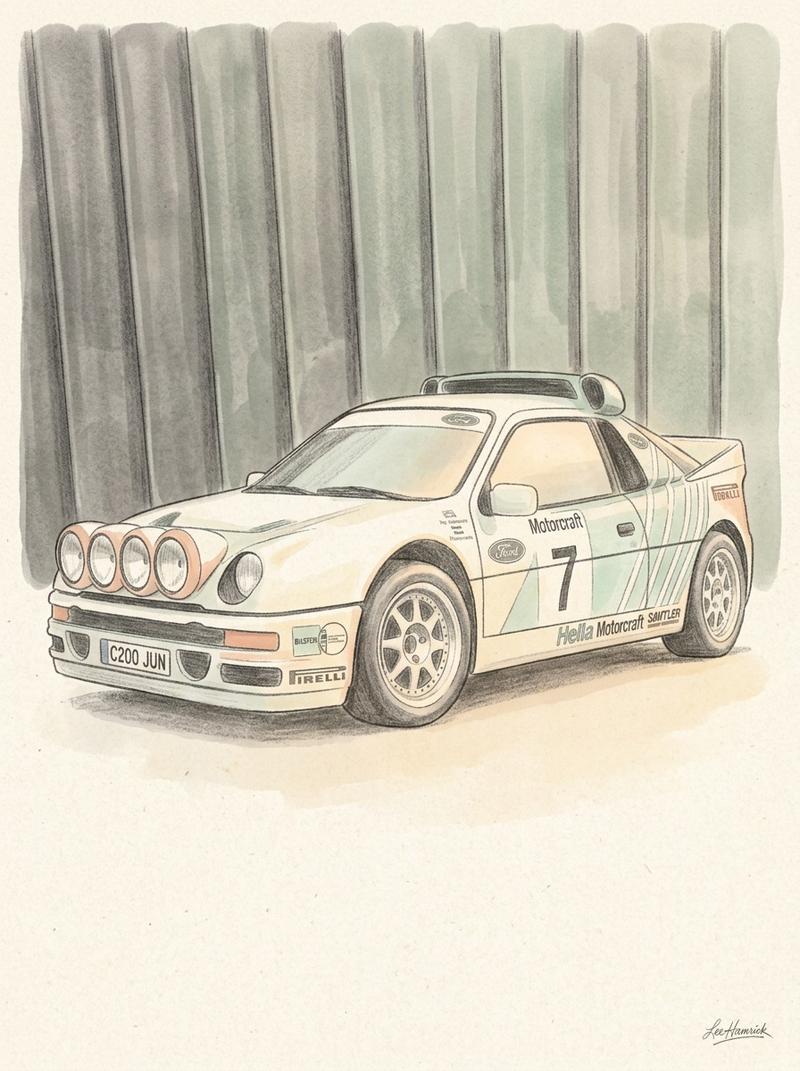
Ford RS200
Ford built the RS200 from a clean sheet specifically for Group B. The construction was composite, the layout mid-engine four-wheel drive, and the chassis by all accounts was genuinely exceptional. The RS200 made its WRC debut in early 1986 and showed pace on the stages it completed. Then the category was cancelled and the RS200 never got a full season to prove what it was. A car designed to do one specific thing, and the one thing was made illegal before the car could finish doing it.
Opel Manta B400
The Manta B400 never contended for the championship. It ran a Cosworth-tuned 2.4-liter producing 275 horsepower, rear-wheel drive, and the actual road-car bodyshell rather than a purpose-built shell wearing road-car styling. Against 400-plus-horsepower turbocharged AWD cars, the Manta was outgunned on paper. On gravel stages, with that linear Cosworth power and a light tail to manage, it was a different story. And it may be the best-looking rally car of the entire era, which is not a small claim given the competition. Sometimes that has to count for something.
Lancia Delta S4
The Delta S4 ran both a supercharger and a turbocharger simultaneously. The Abarth Volumex R18 supercharger covered the low end; the Kühnle, Kopp and Kausch 27 turbocharger came in above 4,500 rpm. The result was power delivery with almost no dead zone, rated at 490 PS (483 hp) with some sources claiming 500 PS, in a four-wheel-drive package that weighed between 890 and 1,050 kg depending on specification. The all-wheel drive system could route 60 to 75 percent of torque rearward through the center differential. Lancia built 28 complete competition chassis and 200 road-going Stradales to meet homologation. The S4 won five of its twelve WRC entries, starting with the 1985 Lombard RAC Rally. It was also the car Toivonen was driving at Tour de Corse. Those two facts now exist together permanently, inseparable, which is one of the harder things about this era to sit with.
Porsche 959
The 959 was developed specifically around Group B regulations: twin-turbocharged flat-six, all-wheel drive, and an electronically controlled AWD system that could vary torque split between axles in real time, ahead of anything comparable in production at the time. Porsche built it for rallying and then rallying went away. So they entered it in the Paris-Dakar instead, and René Metge won the 1986 event outright. A car designed for five-minute forest stages spent its defining moment crossing a desert. It still won. The 959 was that kind of car.
Ferrari 288 GTO Evo
Ferrari's Group B entry never turned a competitive wheel. The 288 GTO Evolution was built to homologation spec, twin-turbocharged, and by the time it was ready the FIA had already made the call to end the category. It ran as a demonstration car and then disappeared into private collections. What survived was the knowledge that Ferrari had been ready to race, that the car existed and was apparently formidable, and a handful of photographs that have fueled arguments ever since about what might have happened if it had actually competed. Sometimes the cars that never raced become the ones people argue about longest.
Renault 5 Maxi Turbo
The Maxi Turbo was Renault's answer to the mid-engine turbocharged format that defined the era: a rear-engine layout replaced by a mid-mounted turbocharged four, rear-wheel drive, and enough power to compete with the factory juggernauts. It was primarily a force in French national rallying and European events rather than a full WRC campaign, which kept it off most people's shortlists. It was quick, genuinely quick, and in the hands of Bruno Saby and others it showed what Renault could do when they committed the engineering resources. The Group B ban ended its development before a full international program could be mounted.
Group B lasted four years. The technology it produced took decades to show up in production cars. The footage still looks like it was filmed on another planet, or in a world where the paperwork hadn't caught up with the physics yet. Spectators inches from the road. Cars making 400 horsepower through forests on gravel. A 200-unit production minimum that let manufacturers build essentially whatever they could engineer.
The regulations opened a door. The cars walked through it. Eventually the door had to close.
The cars are still out there. Some of them run at historic events. The 959 is in museums. The RS200 ended up in private hands. The 037 gets driven occasionally by people who understand what they have. You watch the archive footage and the engines are still screaming, the spectators are still throwing themselves sideways, and the drivers are still threading something insane through a gap that keeps getting narrower.
The gap always closed eventually. Four years. Ten cars profiled here, and the regulations expired and the era went with them, and what's left is footage that still doesn't look real.

Written by
Lee Hamrick