3D Printing for Car People: What Actually Works, What Doesn't

3D printing solves real problems for car builders, but only if you understand material limits, tolerances, and when to skip it entirely.
The pitch sounds perfect: design it, print it, install it. No waiting for supplier lead times. No settling for what exists. No compromise. The reality is narrower, not because the technology fails, but because thermoplastics and load cycles and material science follow rules that no amount of enthusiasm can change.
Spend a weekend printing something for your car and you start learning things the CAD file never taught you. A center console organizer warps in summer heat on the first try. You redesign it. Fails again. On the third iteration, you finally understand what happens when you leave plastic in a July car, and the fourth version doesn't warp because you're no longer fighting physics. The printer did exactly what it was supposed to do. You were the problem.
Most car people approach 3D printing like it's a magic machine that turns files into finished parts. It isn't. It's a tool that trades speed for precision, cost for complexity, and ease for material science you actually have to respect. The difference between what sounds good and what works is where the honesty starts.
Where 3D Printing Actually Wins
Start with what it does better than anything else: rapid prototyping of small structural parts that don't see repeated stress. A custom battery tie-down for a vintage radio install. A dashboard clip that broke fifteen years ago and doesn't exist anywhere anymore. A fuel line routing guide for an engine swap that only you will ever build. These aren't glamorous. They're also not failures. They're engineering problems with finite loads and known geometry, and the printer solves them in a way nothing else can.
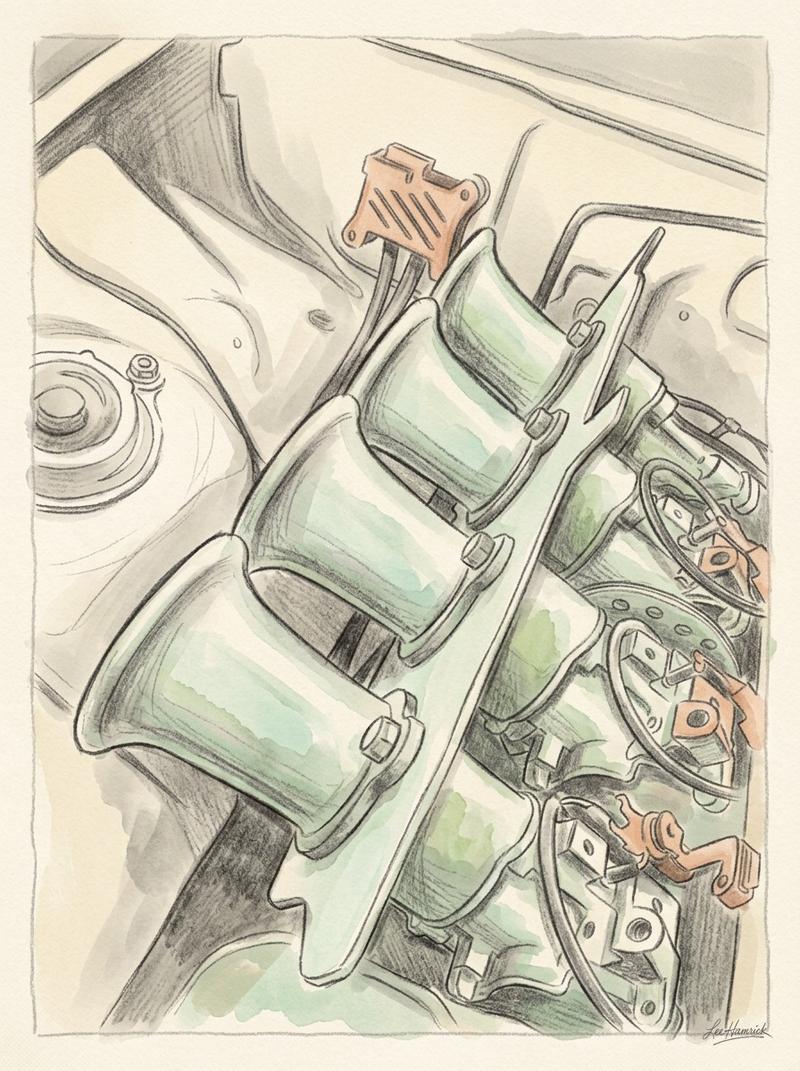
Custom air intake ducting is a genuine win. You design around your specific engine bay, your turbo placement, your radiator location. You print a prototype. You test it. You refine it. Airflow doesn't care that it's plastic. Density and dimensional accuracy are what matter. I've seen intake plenums perform better than stock setups at this scale, because you built it for your specific combination instead of accepting what the factory designed for the least common denominator.
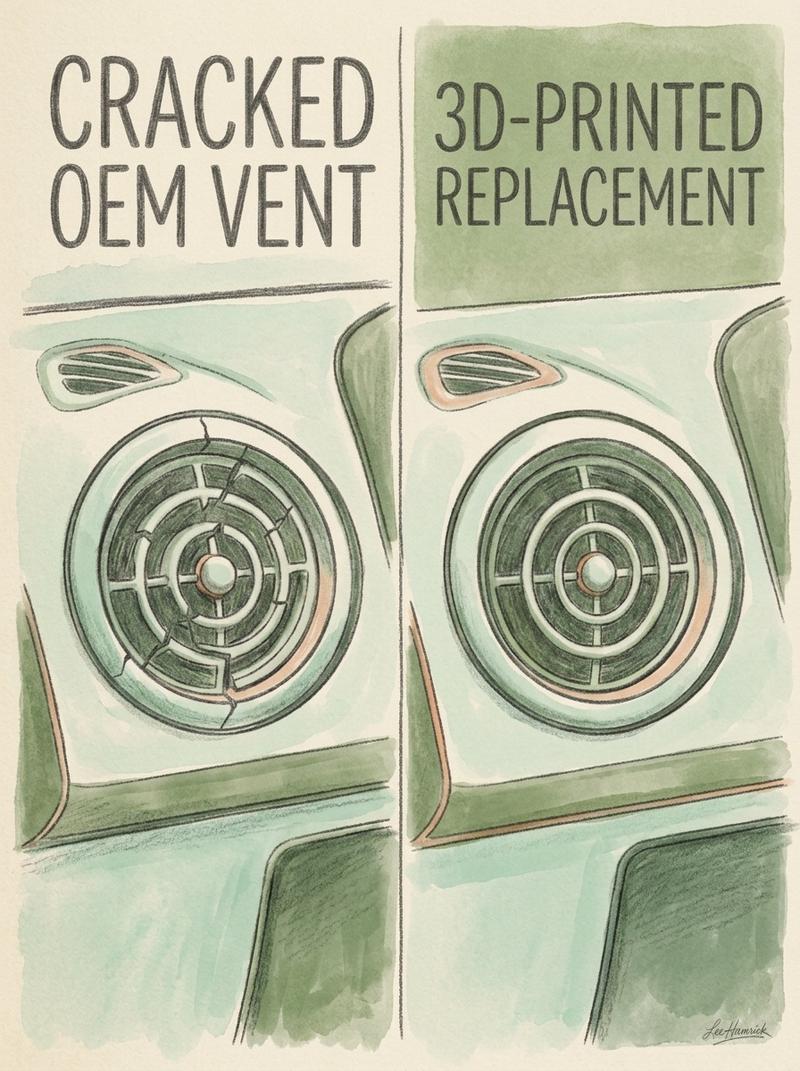
Replacement cosmetic trim sits somewhere between real problem and real stretch. A cracked dashboard cap. A missing air vent diffuser. A broken gauge bezel. If you can scan the original or measure every angle obsessively, printing a replacement is straightforward. The catch is material durability. ABS warps in sunlight. PETG yellows. Nylon absorbs moisture. Resin parts start degrading after two years outdoors. That's not a design flaw. That's photodegradation. Chemistry always wins.
Tolerance matters immediately. Modern resin printers hold 0.1mm accuracy. FDM printers, the plastic filament kind, hold 0.2mm to 0.4mm depending on material and tuning. That's good enough for a clip. It's nowhere close for anything that mates with factory components at tight tolerances. Understanding your printer's actual capability, not the spec sheet fantasy, takes real time and real measuring.
Where It Fails, and Why That Matters
High-temperature engine bay components are a hard no. A thermostat housing living in 90-degree coolant. An intake manifold gasket surface. Anything near the exhaust. The melting points of common printing materials are well below sustained engine temperatures. ABS maxes out at 104 degrees Celsius. Nylon theoretically reaches 220 degrees, but in practice, creep is the killer. Load the part under heat over time and it deforms. Millimeters matter in engine bays. This isn't about choosing the right material. This is thermodynamics telling you no.
Anything under repetitive stress will fail, and the failure will be catastrophic. A sway bar end link sees motion in six directions, thousands of cycles per mile. Print it in plastic and you're not building a part. You're setting an expiration date. A control arm, a tie rod, anything that cycles in load. Fatigue in polymers is well understood. It's also unforgiving. Metal yields and bends. Plastic yields once, then shatters. The difference between deformation and failure is everything when suspension geometry is on the line.
Sealed enclosures are trickier than they look. A custom battery box. A cable routing cover. A sealed component terminal. Moisture finds its way into plastic in ways it never finds into metal. Print something sealed and you've created a humidity trap. Water wicks directly into the material itself. Electronics corrode. Electronics fail. If something needs to stay dry, plan for venting, or plan for a failure that costs more to fix than the original part was worth.
The Cost Problem Nobody Admits
A simple bracket might take three iterations and fifty grams of material. At twenty to thirty dollars per kilogram, you're looking at a dollar fifty in actual plastic. Sounds cheap until you do the actual math. Your printer costs five hundred to three thousand dollars depending on resolution. Your time has value. You need CAD skills or scanning equipment or both. Post-processing takes hours. By the time that bracket is finished, you've spent a hundred dollars in combined time, equipment, and learning. A salvage bracket off eBay costs twelve.
The honest calculation is this: 3D printing wins when the part doesn't exist anymore, or when you're manufacturing ten of them, or when the prototype saves you from ordering the wrong thing. It loses when a stock part exists, when the timeline is tight, or when you're trying to save money on something you can only print once.
What Actually Matters Before You Buy
If you're buying your first printer, resin is more accurate. FDM is more forgiving and cheaper to operate. Start with one, not both. Learn it completely before you assume you understand what the other one can do.
Design for your printer's actual limits, not for what you wish it could do. A 0.4mm nozzle can't print 0.1mm details. A two-hundred-dollar printer can't hold tolerances like a five-thousand-dollar printer. Know that difference before you open CAD.
Material selection is everything. PETG is tougher than ABS. Nylon is tougher than PETG. Resin is more accurate than both. None of them are metal. None should pretend to be. Use them for what they actually are, and they work exactly as they should.
Post-processing is not optional. A printed part needs support removal, surface finishing, and testing before it goes anywhere near the car. Three to six hours of hand work depending on complexity. That's part of the project, not a surprise waiting at the end.
The real value is in the iteration cycle. You can design something today and test it this week. You can get it wrong three times before you get it right. That speed has genuine worth for prototyping, for one-off repairs, for solutions that don't exist in any catalog. For making a standard part cheaper or faster, it isn't worth it.
The Whole Story
Two printers in the garage now. One resin, one FDM. The resin gets used four times a year. The FDM gets used ten times. Neither has made me richer. Both have made problems solvable that weren't before. That's where the real value lives.
3D printing works when you respect what it is and don't ask it to be what it isn't. When you understand the tolerances, the material science, the time investment, and the limitations. When you treat it as a tool in your toolbox, not a solution to everything.
The tolerances work out. The results are honest. You do exactly what you're supposed to do, nothing more. And then you drive the car, which is the whole point anyway.
Written by
Nick Mangino