A $200 Amazon Turbo on a $1,600 Bug: What the Numbers Actually Say
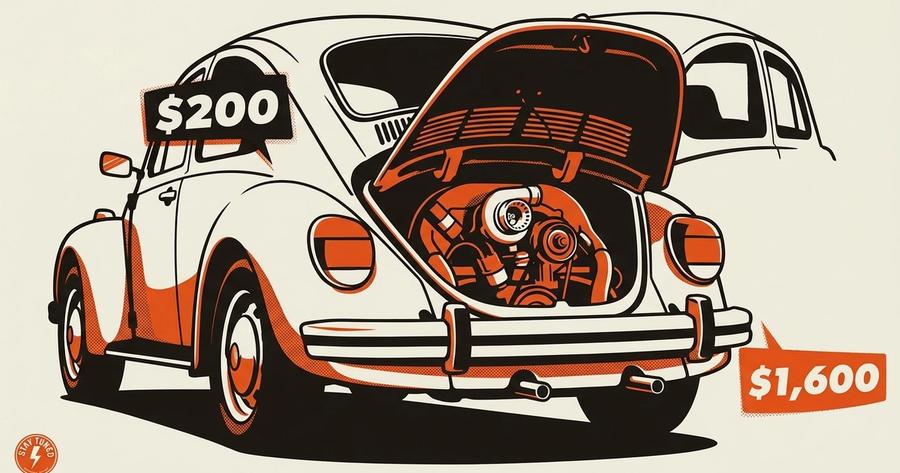
A dirt-cheap turbo on a 1972 VW Super Beetle sounds insane. Here's what it actually costs, what it gets you, and whether the math makes any sense.
The total outlay on this build before turning a single wrench: $1,800. That's $1,600 for a 1972 VW Super Beetle that was already ticketed for the crusher, plus roughly $200 for a turbocharger sourced from Amazon. For context, you can't buy four decent tires for $1,800. You definitely can't buy a running project car and a forced-induction system for that money. Except, apparently, you can.
The Stay Tuned crew, led by Tony Angelo, did exactly that. And the result is either a compelling proof of concept or a very expensive lesson in why you don't bolt a no-name compressor onto a fifty-year-old air-cooled engine. Probably both.
What You're Starting With
The 1972 Super Beetle is not a performance car. It never was. The Super Beetle designation referred to a revised front suspension and a larger trunk, not anything under the lid. The base air-cooled flat-four in these cars made somewhere in the neighborhood of 60 horsepower when new, which was already not impressive in 1972. After fifty years of use, deferred maintenance, and whatever a car destined for the crusher has been through, you're almost certainly making less than that.
Zero to 60 in a stock, tired Super Beetle? Expect something north of 20 seconds in real-world conditions. That's not a typo. These cars were slow when they left Wolfsburg. Time has not helped.
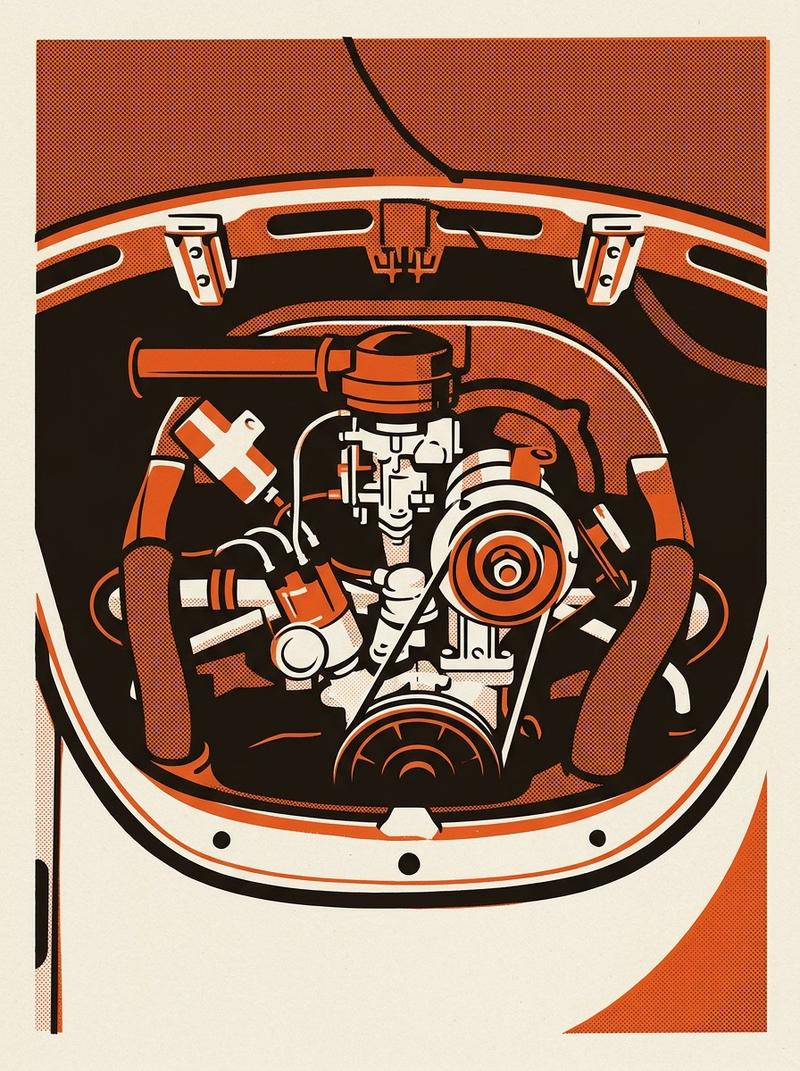
So the baseline here is genuinely bad. Which is actually useful context, because it means even a modest power increase shows up clearly in the numbers. You don't need to double the horsepower to cut the 0-60 time in half when you're starting from 20-plus seconds. You just need to move the needle enough to matter.
The Case For a Cheap Turbo on an Air-Cooled Engine
Here's the thing about turbocharged air-cooled VW builds that enthusiasts have known for decades: the basic architecture isn't hostile to forced induction. The Type 1 engine is a simple, over-square design with a long history of being pushed beyond its factory limits. VW's own factory turbocharged Type 1-derived engines in competition applications going back further than most people remember. The aftermarket for Type 1 go-fast parts is deep and old.
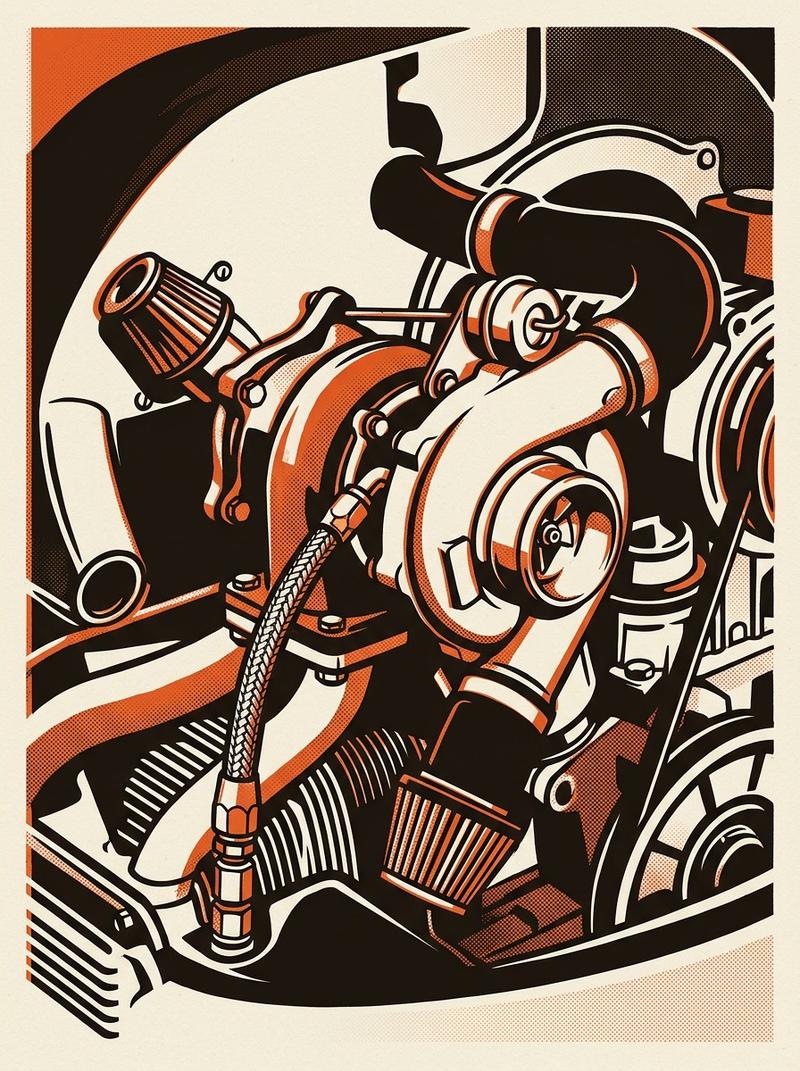
The wild card is heat. Air-cooled engines already run hot, and turbocharging adds heat on both ends of the system. A $200 Amazon turbo is not going to have the same heat management characteristics as a purpose-built unit. The intercooler situation on a car this size and this configuration is genuinely complicated. Boost pressure management on an engine with no factory electronic controls requires attention.
None of that is necessarily fatal. It just means the cheap-turbo path requires either careful tuning or a high tolerance for rebuilding engines. Preferably both.
The Real Cost Breakdown
The $1,800 headline number is real but incomplete. Here's what a build like this actually accumulates:
- Car: $1,600
- Turbo unit: ~$200
- Supporting hardware (intake piping, exhaust modifications, oil feed and return lines, boost gauge, basic tuning provisions): figure $300 to $600 depending on how much fabrication you do yourself versus buying pre-made pieces
- Engine refresh before boosting (and you should refresh it before boosting): new rings, valve seals, a compression check and any remediation needed -- budget $200 to $400 for parts if you're doing the labor
- Unexpected repairs on a $1,600 car that was heading to the crusher: plan for at least one surprise in the $150 to $300 range
Realistic all-in number before paint or cosmetics: $2,500 to $3,000. That's still a remarkable budget for a running, driving, turbocharged classic VW. It's just not quite the $1,800 the headline implies.
What You Actually Get Performance-Wise
A conservatively boosted Type 1 running 5 to 7 psi on a healthy short block can reasonably make 80 to 90 horsepower at the crank. That's a 30 to 50 percent improvement over a worn stock engine. On a car that weighs roughly 1,900 pounds, that power-to-weight shift is meaningful in a way it wouldn't be on a heavier modern car.
Cut the 0-60 time in half? That's the question the build sets out to answer. Getting from somewhere around 20 seconds to somewhere around 10 is theoretically achievable with that power bump, assuming the rest of the drivetrain holds together and the tune is reasonable. Whether the $200 Amazon turbo survives long enough to produce consistent results is a separate question entirely.
The honest answer is: probably close, but not reliably. You'll see dramatically better acceleration in the best runs. You'll also see heat soak, inconsistency, and the occasional run where something isn't quite right. That's the deal with budget forced induction on old hardware.
The Insurance and Ownership Reality
A modified classic VW is not straightforward to insure through standard carriers. Agreed-value classic car policies from specialists are the right move here, and most of them have mileage restrictions and storage requirements that don't match a daily driver use case. If you're building this as a weekend car and occasional show piece, the insurance math works fine. If you're planning to drive it regularly, factor in the cost difference between a standard policy (which won't reflect the car's actual value after the build) and a specialty policy that will.
Repair costs on a built air-cooled VW are also unusually predictable. There's no proprietary dealer network, no dealer scan tool requirement, no modules to program. Parts availability for Type 1 engines is genuinely good. Labor costs are low because the architecture is simple. From a total cost of ownership standpoint, a well-sorted turbocharged Super Beetle is probably cheaper to keep running than most modern performance cars with comparable acceleration numbers.
Should You Actually Do This
The build makes sense under specific conditions. You need to enjoy the wrenching process, because a $200 turbo on a crusher-spec engine is going to require ongoing attention. You need to be realistic about the performance ceiling, because you're never going to make this a quick car by modern standards, just a more interesting slow car. And you need to go in with eyes open on the real budget, not the headline number.
What you get for the money is something genuinely rare: a car with a story, mechanical simplicity that rewards learning, and performance gains that are actually perceptible because the baseline was so low. The $200 turbo might not last forever. The experience of building it almost certainly will.
This is the deal right now on classic air-cooled VWs. Prices are still accessible, parts support is strong, and the modification ecosystem is deep and cheap. The window where a Beetle is a $1,600 crusher candidate instead of a $8,000 restored weekend car is probably not permanent. Build it while the math still works.

Written by
Zach Bronstein