A Gambler 500 Mea Culpa

Tom Kubo revisits the Gambler 500 after seven years away and finds that 5.5 million pounds of trash collected changes the narrative considerably.
Since 2018, the Gambler 500 and its sister organization, Sons of Smokey, have removed 5.5 million pounds of trash from public lands. The founder claims more than any other organization on the planet. I have no reason to dispute it.
I left the event in 2019 convinced it had jumped the shark. I was wrong. That is the short version of this article. The rest is the documentation.
What I Thought I Knew
I attended the first three public Gambler 500 events, starting in 2017. The formula was simple and appealing: buy something close to worthless, drive it somewhere it probably shouldn't go, cover somewhere in the neighborhood of 500 miles, and don't die. The routes were unofficial. The mileage was approximate. The cars were spectacular garbage.
By 2019, the crowds had grown, the energy had changed, and I walked away thinking the event had become more about performance than purpose. I filed it away and moved on.
That read turned out to be incomplete.
The Founder
Tate Morgan arrived at our conversation on an aging Japanese commuter scooter. He is approximately six and a half feet tall, gray-bearded, and wearing a custom Gambler 500 poncho. He looks like someone who has never worried about anything and also has strong opinions about everything.
Behind him, a John Deere backhoe was methodically dismantling an abandoned trailer that had been dragged off public land into Gambler Town for disposal. The previous occupants' belongings were coming out with it. A child's toy truck landed in the dirt near a dumpster.
Morgan noted we were downwind. Practical man.
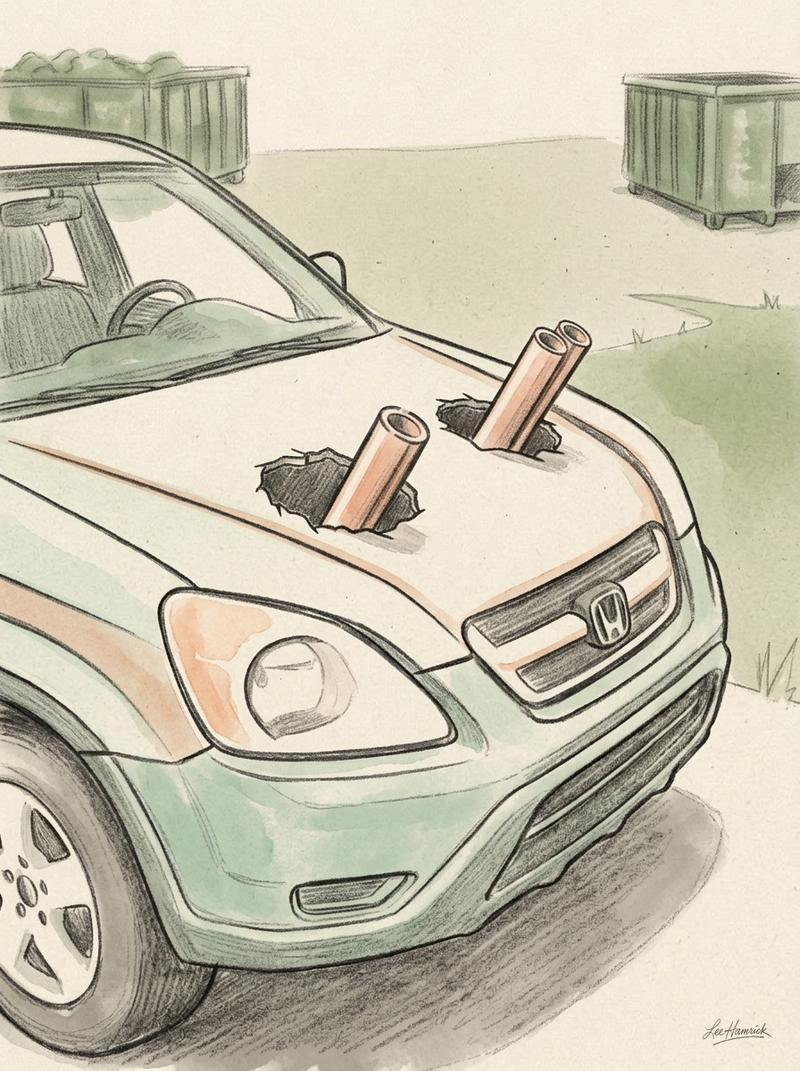
Nearby, a second-gen Honda CR-V was revving against its limiter, straight-pipe exhaust routed through holes cut in the hood, registering somewhere above 115 decibels. Morgan said he had spoken to that driver six or seven times the day before. His description of the driver was brief and accurate.
The Route I Chose
Morgan offers three route options. The short one is called Madras Meander. There is a middle option that passes through Bend. The long one is called The Devil's Butthole, with a subtitle referencing the distance one must travel to reach the top if one wishes to rock and roll.
My buddy Willy and I chose The Devil's Butthole. We drove my 1976 International Scout Traveler, which is equipped with a 345 cubic inch V-8 and qualifies as Gamblin' equipment by any reasonable standard. The dogs came. Breakfast that morning was half a bag of watermelon gummy candies and black coffee, which I mention only to establish that the Scout was the most competent element of the morning's operation.
We headed southeast from Portland on Highway 26, over Mt. Hood, toward Madras. Then south on 97 toward La Pine. Then left onto a dirt two-track east of La Pine, toward Hole in the Ground.
Ninety minutes past Madras, we had not seen another Gambler. In previous years, the routes were dense with other participants. This year, on the long route, the population was essentially zero.
By six in the evening, fifteen miles down that two-track, a late-June cold front arrived. We made camp and decided to reassess in the morning.
The Infrastructure That Actually Matters
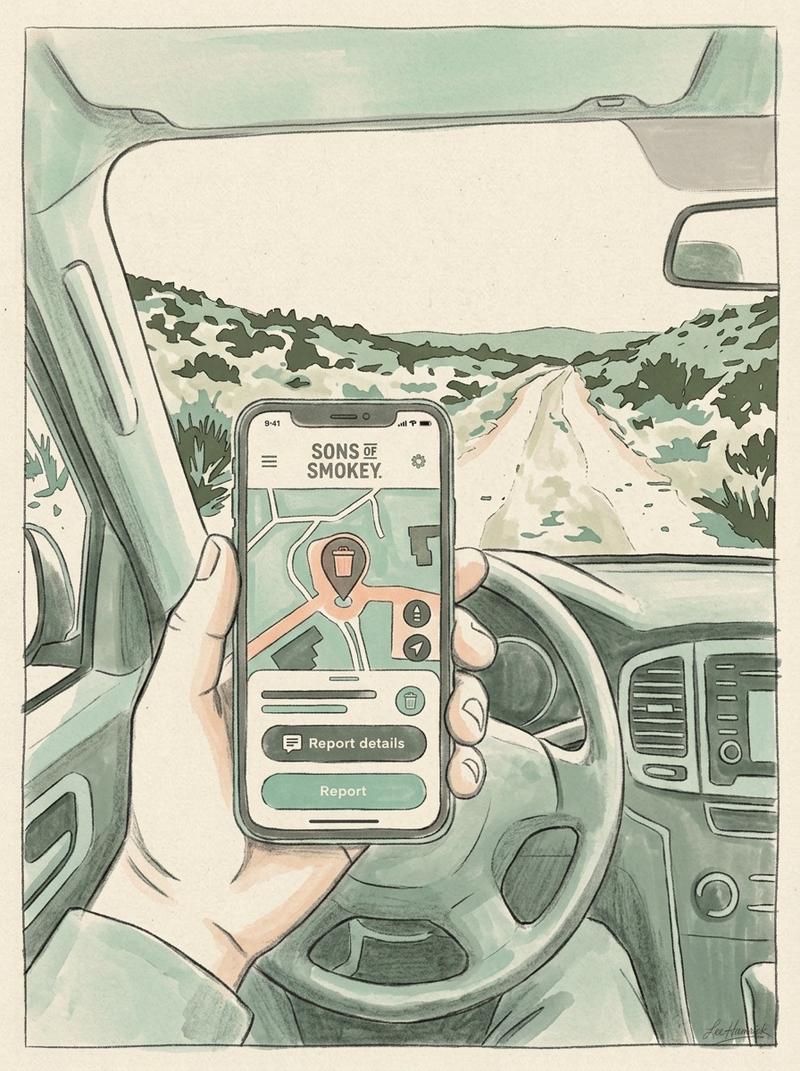
Willy pulled up the Sons of Smokey app on one bar of signal. It is a free application, built to consolidate what had been a fragmented collection of reporting systems used by private groups, public agencies, and volunteer organizations tracking illegally dumped garbage and abandoned vehicles on public land.
The mechanics are straightforward. You locate trash on public land. You tag it in the app with coordinates, garbage type, approximate volume, and what size vehicle the extraction will require. Someone else navigates to that tag and removes it. The tag closes. This is what moves 5.5 million pounds.
The Bureau of Land Management in Utah now uses Sons of Smokey to manage dump sites across its land. The Forest Service, which once regarded the Gambler with institutional suspicion, now sends rangers and crews to work cleanups alongside participants. That is a meaningful shift in posture from a federal agency. Federal agencies do not update their posture quickly.
The Gambler 500 is now in its tenth year. The hooliganism is still present. The CR-V against the rev limiter at 115 decibels establishes that clearly. But the event has developed a logistics layer that produces measurable output at scale, and that output is legitimate.
What I Got Wrong
In 2019, I looked at the crowd and concluded the event had lost its thread. The tolerances here are worth noting: I was measuring the wrong thing. I was evaluating energy and atmosphere. The actual output, trash removed, land cleared, a functional reporting app adopted by federal land managers, was running in parallel and I missed it entirely.
The event is still chaotic. Organized chaos is still chaos. Morgan would not argue otherwise. But there is a difference between an event that is chaotic and an event that is chaotic and produces nothing. The Gambler 500 produces something. It does exactly what it says it does, which is more than I gave it credit for.
5.5 million pounds is not a vibe. It is a measurement. I measured it. Twice.

Written by
Tom Kubo