The 996 Turbo Used to Be Cheap. Pristine Ones Are Crossing $155,000 Now.
996 Porsche 911 Turbo prices are climbing fast. Here's what's driving the market and what buyers need to know before writing a check.
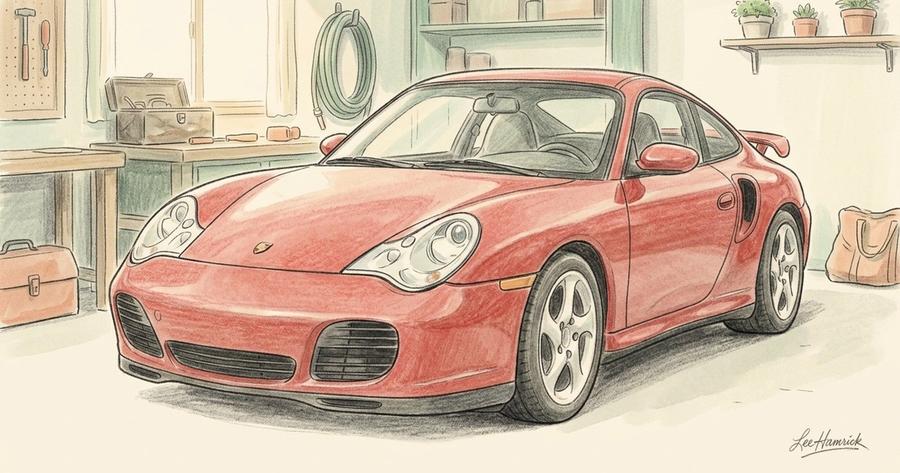
$155,666. That number landed on Cars and Bids for a red 996-generation Porsche 911 Turbo with 20,700 miles, the X50 power kit, hardback sport seats, and a manual gearbox. It had some aged weatherstripping and a few paint chips. It sold anyway.
Eighteen months ago you could have bought a running, driving 996 Turbo for the price of a new Mustang GT. That window appears to be closing.
The 996 Turbo was never the loved one. The 993 it replaced had 35 years of air-cooled engineering behind it, and the standard 996 Carrera arrived at Frankfurt in September 1997 breaking most of what people thought a 911 had to be: water cooling, top-hinged pedals, and those composite headlights that unified the turn signals and low beams into a shape that split opinion immediately. The interior was noticeably more plastic than the hand-built cars that came before it. Production volumes were higher. And then the 997 arrived in 2005 with round headlamps back and a cabin that felt like it actually belonged in something costing what Porsches cost, and the 996 settled into a long stretch of relative neglect on the used market.
That's the context for why a $155,000 sale feels like news.
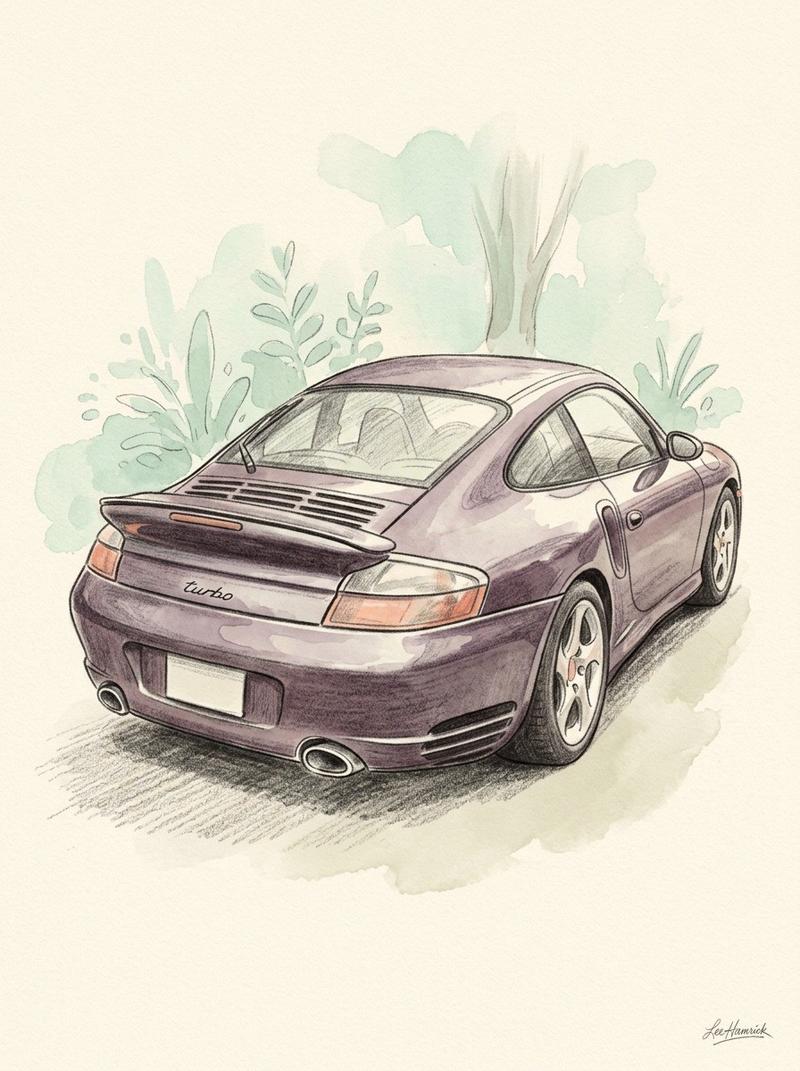
The Turbo itself debuted at Frankfurt in September 1999, per Porsche's own history, and went on sale in the US as a 2001 model year car, running through the 2005 model year, with 21,954 total built across all variants, according to Supercar Nostalgia. Those early 2001 Turbos wore the same so-called fried-egg headlights as the 986 Boxster, a parts-sharing measure driven by Porsche's cost-reduction strategy at the time. The entire 996 generation received a mid-cycle facelift for 2002, the so-called 996.2. As Hagerty's buyer's guide states plainly, the most noticeable change came with a redesigned headlight no longer identical to the Boxster. Excellence magazine has noted that owners did not want their 911s confused with the less expensive car. The Turbo carried its twin-turbocharged 3.6-liter Mezger engine and AWD through both phases, rated at 415 hp. An optional X50 Power Kit became available from 2002, lifting output to 444 hp on standard Turbos. According to stuttcars.com, the X50 kit comprised larger K24 turbochargers, upgraded intercoolers, a revised ECU, and a free-flow quad-pipe exhaust, along with a reinforced gearbox. Supercar Nostalgia adds that the turbochargers ran boost pressure raised from 0.8 to 0.9 bar. The kit was not retrofittable to 2001 cars. The Turbo S arrived exclusively for the final 2005 model year as a swan-song variant: it bundled the X50 kit as standard equipment, raising output to 450 hp and 457 lb-ft of torque, and added Porsche Ceramic Composite Brakes as standard along with aerodynamic enhancements and exclusive Turbo S badging. Cabriolet buyers in that spec automatically received an aluminum hardtop. Production numbers were extremely limited: 600 Turbo S Coupes and 963 Turbo S Cabriolets, versus 16,965 standard Turbo Coupes and 3,426 standard Turbo Cabriolets.
The X50 car on Cars and Bids isn't alone at the top. Two weeks before it sold, a 996 Turbo S crossed the block on Bring a Trailer at $168,000. That one had 21,000 miles, the X50 power kit bundled in as part of the Turbo S package, carbon-ceramic brakes, and a Paint-to-Sample color called Viola Metallic, a deep dark purple that generates its own demand. It was also a cabriolet, which usually cuts value by something close to 30 percent because the soft top adds weight, reduces rigidity, and adds maintenance complexity. The market shrugged at that and bought it anyway.
What separates these cars from the $40,000 and $50,000 examples that were easy to find in early 2025 is condition and mileage, mostly. Below 25,000 miles, original paint, unmodified mechanicals, documented service history. The cars in the five-figure basement are higher-mileage, often modified, and carry the deferred maintenance that any 20-plus-year-old car accumulates regardless of how it was stored. Those cars still exist. They're just thinner on the ground than they were. Per Classic.com data cited by The Autopian, the average market price for a 996 Turbo sits around $64,812, while Turbo S examples average $92,655 and a record 996 Turbo S sale of $730,000 was recorded in July 2026 for an exceptional example. European median prices for the 996 Turbo climbed from roughly 70,000 euros in January 2026 to roughly 80,000 euros by April and May 2026, with average time on market dropping from 54 days to 28 days year-over-year, a clear signal of accelerating demand.
Before anyone asks the obvious question about the 996's mechanical reputation: the concern that follows every 996 Carrera discussion is the IMS bearing. It does not apply here. According to LN Engineering, the definitive authority on the subject, the IMS bearing failure that affects M96 and M97 normally aspirated engines does not affect the 996 Turbo. The Turbo uses the Mezger engine, derived from the 911 GT1 race car, which feeds oil-pressure-lubricated plain bearings to both ends of the intermediate shaft rather than the sealed, unlubricated ball-race bearing used in the M96. LN Engineering states explicitly that "Porsche 996 and 997 GT3, Turbo, and GT2 Mezger engines have oil pressure fed plain bearings on both ends supporting the IMS shaft, therefore they do not have IMS bearing problems." The 996 Turbo's real reputation concerns are the shared-Boxster styling on pre-facelift cars, a relatively cheap-feeling interior for its launch price, and the maintenance costs of a high-performance twin-turbo AWD car as it ages. Not engine reliability.
What the 996 Turbo offered when it was new, and still offers now, is a combination that sounds simple and proved difficult to replicate. More than 400 horsepower from the base twin-turbocharged flat-six, all-wheel drive, rear seats, windows you can actually see through, and steering that told you what the front tires were doing. The X50 power kit pushed output to 444 hp on standard Turbos, and to 450 hp in the Turbo S. You could specify a six-speed manual. It was a car you could take to the grocery store on Tuesday and a track day on Saturday and neither trip felt like a compromise.
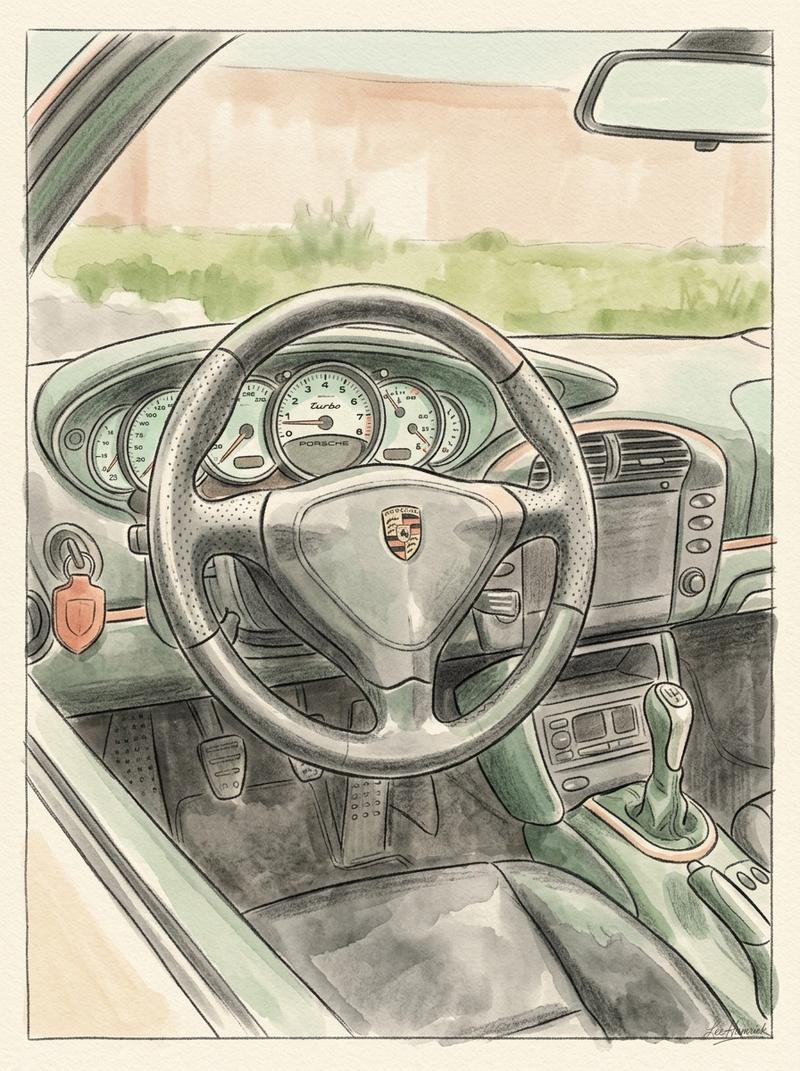
The comparison that complicates the $155,000 ask, though, is sitting in Porsche showrooms right now. The 911 Carrera T starts at $135,995 including freight, per Motor Authority. It's rear-wheel drive where the 996 Turbo is all-wheel drive, and it gives up some horsepower. It's lighter. The steering still communicates. The seats are not comparable to the hardback sport seats in the old car because they're better. It comes with a six-speed manual and a full warranty. Even a 20,000-mile 996 Turbo is still a 20-year-old car, and every aging system on it, bushings, gaskets, rubber, turbo plumbing, eventually costs you time or money or both. And if you want the full Turbo experience new, the 2026 992.2-generation 911 Turbo S, now a T-Hybrid with 701 hp, starts at $270,300 before a $2,350 destination fee, with options capable of adding tens of thousands more on top of that.
I understand paying a premium for an experience you genuinely cannot buy new. A 930 Turbo, an AW11 MR2, an original Mini, these are cars with no modern equivalent. The 996 Turbo case is more complicated because the modern equivalent exists and costs roughly the same and is faster. What you're actually buying in the old car is the specific shape of the experience: the low windowsills, the visual drama of those controversial headlights that the market has clearly made peace with, the absence of a screen dominating the dashboard, the particular sound signature of that flat-six under twin-turbo boost. Those things are real. Whether they're worth $155,000 plus whatever the first major service costs is the question each buyer answers for themselves.
The broader 996 Turbo market hasn't uniformly moved to six figures. The modified cars and the higher-mileage cars and the cars with unclear histories are still out there at prices that look approachable compared to what the clean ones are doing. But the floor has risen and the ceiling has broken through what most people would have predicted two years ago.
The weatherstripping on that red car still needs replacing. The buyer paid $155,666 and drove it home.

Written by
Lee Hamrick