Demon-Swapped Trackhawk: What Happens When a Totaled Celebrity Jeep Gets a Second Life

A totaled widebody Jeep Grand Cherokee Trackhawk gets a built Demon engine and larger supercharger in a full salvage-title resurrection build.
There is a particular kind of automotive logic that only makes sense to people who have spent real time at salvage auctions. You walk the rows, you look past the crumple and the airbag dust, and you start doing math in your head. Not just purchase price math, but total-picture math: what is this thing worth fixed, what will the swap cost, what does insurance look like on a salvage title, what is the parts situation when something breaks two years from now. Most people see a wrecked car. The right kind of person sees a platform.
When a famously totaled, widebody Jeep Grand Cherokee Trackhawk surfaced on Copart, that math had an extra variable attached: the car had a story, and whoever bought it was going to inherit that story. The bid went in. The bid won. And then the real work started.
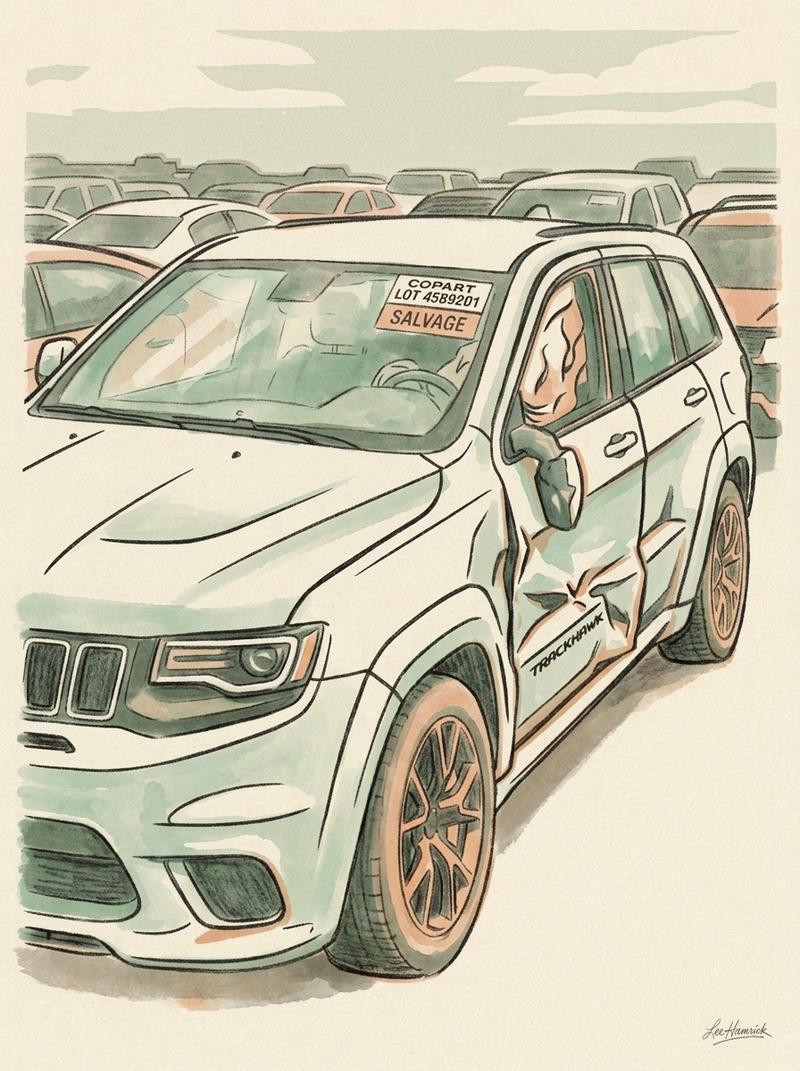
The stock Trackhawk is not a subtle machine. Jeep dropped the 707-horsepower supercharged 6.2-liter Hellcat V8 into a Grand Cherokee, bolted in an all-wheel-drive system capable of actually putting that power down, and called it a family SUV. On paper it sounds absurd. On a highway on-ramp it sounds like a legitimate argument. A widebody kit pushes that presence even further, flaring the fenders and squaring off the stance in a way that makes the standard Grand Cherokee look timid by comparison.
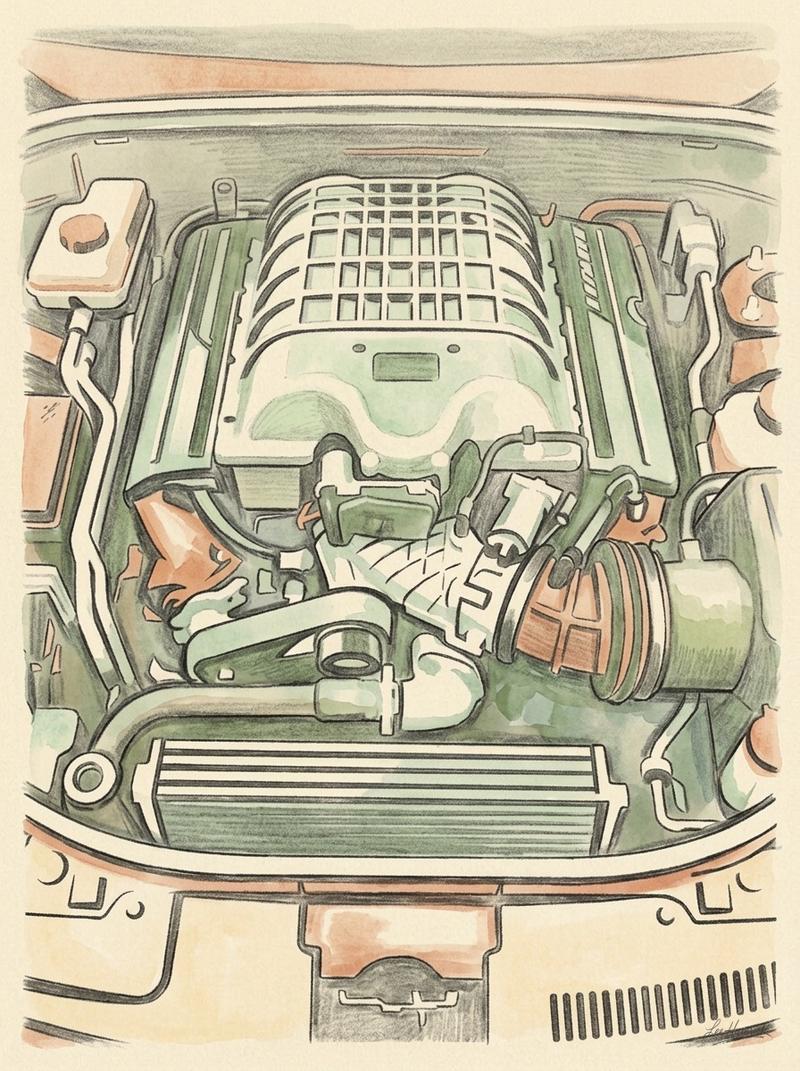
But 707 horsepower is apparently just a starting point when you are already working with a salvage-title platform and nothing left to lose on the stock internals. This build goes further: a built Demon engine, which means the 6.2-liter supercharged unit tuned and internally reinforced to handle power levels the factory never intended, paired with a larger supercharger than the stock unit. The Demon engine in stock Dodge Challenger SRT Demon trim was rated at 808 horsepower on premium pump gas and 840 on the 100-octane race fuel the car could theoretically run. A built version of that block with a larger blower is chasing numbers well past that, and the Trackhawk's AWD system becomes the delivery mechanism for all of it.
That combination raises a real question that matters beyond the spectacle: can the rest of the drivetrain survive it? The Trackhawk's transfer case and rear differential were engineered around the Hellcat's output, not the Demon's. When you start adding displacement-equivalent power through a larger supercharger and internal engine work, the downstream components become the next conversation. Axles, driveshafts, and the transmission all enter the failure-point calculus. A build like this either addresses each of those proactively or it addresses them reactively, usually in a more expensive and inconvenient way.
The Copart angle is worth dwelling on. Buying a totaled vehicle at a salvage auction is not inherently a bad financial decision, but it is a decision that requires complete honesty with yourself about what comes next. Salvage titles kill resale value and complicate insurance in ways that don't always show up until you need them to. Some states are harder than others to get a rebuilt title through inspection. And if the car was a high-profile vehicle before it got wrecked, you are also paying a premium for the story, not just the metal.
None of that is necessarily a reason to walk away. If the end goal is a purpose-built, high-output build on a platform you understand, a clean-title example of the same car might actually cost you more by the time you subtract what the salvage discount gave you. The math has to pencil out across the whole picture: auction price, title work, inspection fees, parts to put it right before you even start the performance work, and then the build itself on top of that. Anyone who has run that spreadsheet honestly knows it gets complicated fast.
What makes this particular build interesting beyond the horsepower figure is the combination of the platform and the intent. The Trackhawk was already doing something genuinely unusual in the SUV market: genuine supercar performance numbers wrapped in something that seats five and tows a reasonable load. Demon power in that same package moves it into a different conversation entirely. It is not a track build in the traditional sense because a two-and-a-half-ton widebody Jeep is never going to be a track build. It is something else: a straight-line weapon with AWD traction and enough interior space to feel almost practical, in the same way that a .44 Magnum feels almost practical as a kitchen implement.
The larger supercharger element is where the engineering gets genuinely interesting. The 6.2-liter Hemi-based block responds well to boost because the architecture was designed with forced induction as a first-class consideration, not an afterthought. When you upgrade the supercharger, you are increasing the pressure ratio the engine sees, which means more air mass per cycle and correspondingly more fuel demand. The tune has to keep up with that, and the fuel system has to keep up with the tune. On a built engine with reinforced internals, the question of where the limit actually is becomes a moving target that you only find by pushing until something says no.
That is the honest reality of a build at this level. It is not a weekend project or a bolt-on exercise. It is a commitment to a platform, an engine family, and a level of fabrication and tuning work that requires either deep personal expertise or a very good shop relationship, preferably both. The Scrap Life crew has been doing salvage-title resurrection builds long enough that the process is visible in how they approach the work, not just what the finished product looks like.
Whether this thing ends up at a dragstrip or a car meet or just gets driven on canyon roads at absurd speeds, the build philosophy is the same one that has always driven the most interesting cars in this hobby: take something broken, understand it completely, improve on what was already there, and make it yours. That part has nothing to do with whose name was attached to it before the auction.
Written by
Nick Mangino