Why You Should Weld Your Own Jack Stands From Scrap Steel

Building DIY jack stands from scrap hollow steel is cheap, strong, and totally doable with basic welding skills. Here is how to think through the build.
Let me tell you what is sitting in the corner of my garage right now: a pile of hollow steel offcuts from old projects that I kept telling myself I would use someday. Someday is today. Because jack stands are one of those shop tools that you either have enough of or you definitely do not, and buying a new set every time you need to support another corner of a car adds up faster than you think.
The short version: you can weld a fully functional, genuinely strong set of jack stands out of scrap hollow steel, spend almost nothing, and end up with something more satisfying than anything you pulled off a Harbor Freight shelf. I ran the geometry on this and the engineering logic is not complicated once you understand what a jack stand actually has to do.
What a Jack Stand Actually Does (And Why the Physics Matter)
A jack stand has one job: hold a static load without tipping, buckling, or collapsing. That is it. There is no dynamic load here. The car is not moving. The stand is not rotating. You are talking about compressive strength and base stability, both of which hollow steel section handles extremely well.
Structural hollow steel, even light wall thickness tube, has outstanding compressive strength along its axis. The reason is simple: the load goes straight down through the tube wall, and steel in compression along its axis is one of the strongest configurations you can put that material in. This is not a coincidence. It is why buildings use steel columns. It is why roll cages use tube. The geometry works in your favor.
The critical variables are:
- Wall thickness of the hollow section (thicker is obviously better, but even moderate wall tube handles car weight without issue)
- Base width relative to height (wider base, lower tip-over risk)
- Weld quality at every joint (this is where the build lives or dies)
- The saddle or top contact point (it needs to distribute load, not concentrate it on a single edge)
None of this requires engineering software. It requires basic shop sense and honest self-assessment of your weld quality.
The Build Logic: Thinking Through the Design
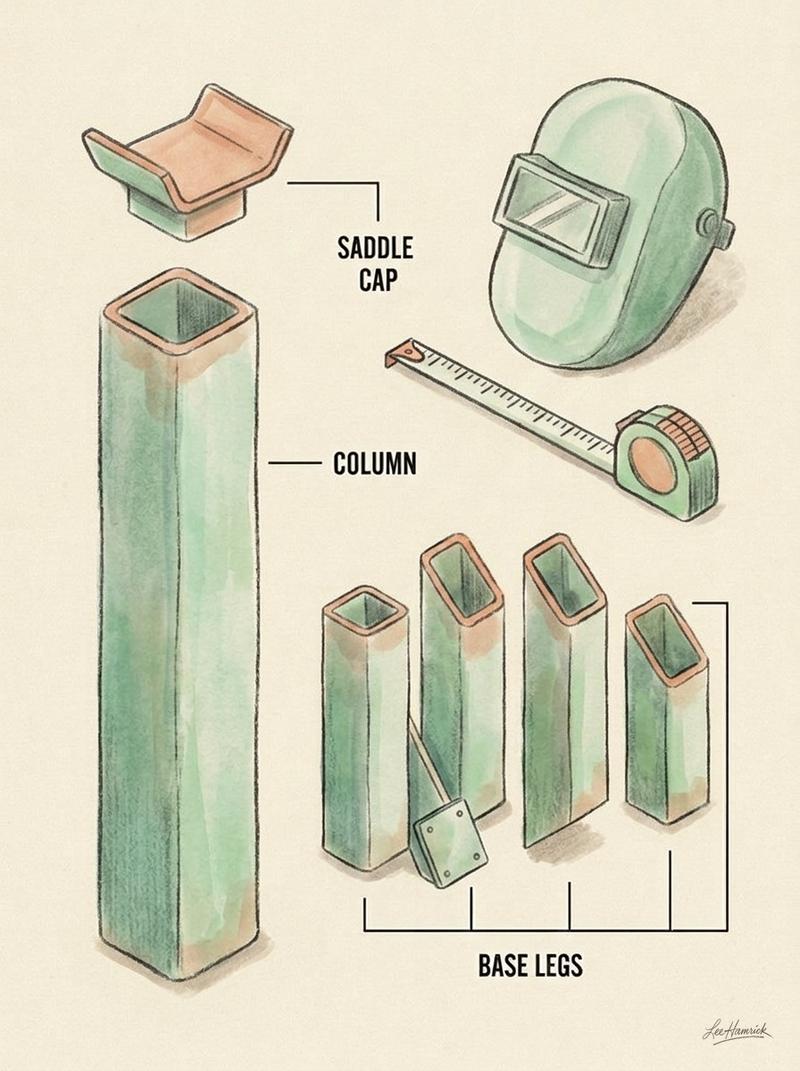
A functional DIY jack stand is not complicated to design. You are working with a vertical column, a base that spreads load outward, and a top saddle that contacts the vehicle's pinch weld, frame rail, or designated lift point. Three components. The complexity comes from making sure the proportions are right and the welds are complete.
For the column, square hollow section is easier to work with than round tube because it gives you flat reference surfaces for layout and welding. If you have round tube, that works too, but your base gussets need to wrap the curve properly or you will have incomplete fusion at the joint.
The base needs to be wider than you think. A narrow-base stand that is tall enough to get under a car on jack stands is a stand that wants to tip over the moment the car shifts weight. The base plates or legs should extend out far enough that tipping the stand requires moving the contact point significantly off-center. In practice, this means your base footprint should be at least as wide as your stand is tall, and wider if you can manage it.
The top saddle is not optional. You cannot just rest a pinch weld on a raw tube edge. That concentrates all the load on a small contact line, and it will either deform your rocker panel or let the car slip sideways. Weld a flat plate cap on top, or a shallow V-channel if you are feeling ambitious, and grind any sharp edges that could bite into the car's body.
Weld Quality Is Not Negotiable Here
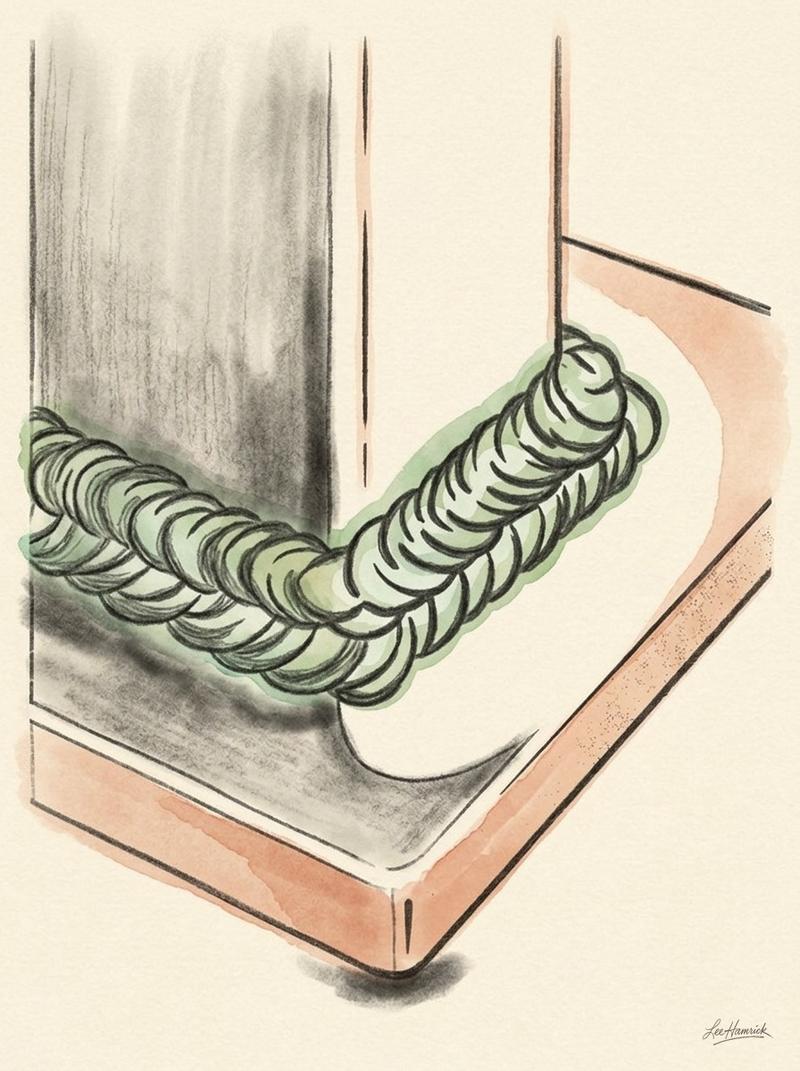
I want to be direct about this: the stand is only as strong as its weakest weld. A partial-penetration weld on a base joint is a time bomb. It might hold for six months and then fail on the seventh jack stand use, and when it fails, a car comes down on you or the floor or whatever is unlucky enough to be nearby.
If you are not confident in your welding, this is a project to practice on scrap first and build the actual stands second. Full fusion at every joint. No undercut. No porosity you are ignoring because it looks small. Grind the welds, inspect them, and if something looks wrong it probably is wrong.
This is not me being paranoid. This is the one place in a DIY build where you do not get a second chance to be right. If you want a broader perspective on what actually matters when you are working on your own car, Three Things Your Mechanic Actually Needs You to Know is worth a read.
What Scrap Steel Actually Works
Not every piece of scrap hollow steel is appropriate for this. Here is how to sort the pile:
- Structural tube with visible surface rust is fine after cleaning. Internal rust that has compromised wall thickness is not.
- Bent or kinked sections are not suitable for load-bearing columns. The kink is a stress concentration point. Cut past it and use the straight portion.
- Mystery steel with no known origin is acceptable if the wall thickness is substantial and the material mills and welds cleanly. If it does not weld predictably, do not trust it.
- Thin-wall decorative tube or conduit is not what you want for the column. Save that for the saddle cap or cosmetic parts if you want, but the structural column needs real wall thickness.
Square tube in the 2-inch to 3-inch range with at least 3/16-inch wall is where I would aim for a stand that will hold anything up to a full-size truck without making me nervous. Heavier is fine. Lighter works for motorcycles and light cars with appropriate height limitations.
Cost Reality Check
If you are pulling true scrap from your own pile, the material cost is zero. Welding consumables are negligible. A wire wheel and some flat black paint to finish them off costs a few dollars. The time investment is an afternoon if you are moving at a reasonable pace.
Compare that to a set of quality commercial jack stands, which run anywhere from moderate to genuinely expensive depending on rated capacity and brand. For the price of materials you already own plus an afternoon of actual shop work, you end up with stands that are sized exactly to your common use cases, built to a quality level you personally verified, and finished to whatever standard you hold yourself to.
I ran the numbers and for anyone who already welds and has scrap steel on hand, there is no argument for buying over building. The commercial stand does not know your car better than you do. It was not designed with your specific lift points in mind. And it definitely was not welded by someone who understands what is going to be sitting on top of it.
The Ranked Verdict
DIY hollow steel jack stands built from scrap are: cheaper than buying, customizable to your exact height requirements and load ratings, and more satisfying to use on every subsequent repair job. The engineering is not complicated. The skill requirement is honest welding, not wizardry. The only reason not to build them is if you do not weld at all, in which case the right answer is to learn to weld, not to skip the stands.
Build them wide, build them solid, inspect every weld before you trust your car to them, and you will have stands that outlast whatever vehicle you are currently working on and the next three after that.

Written by
Ben Eckels