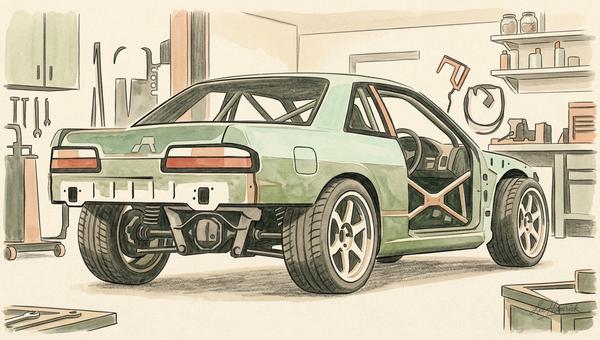
How to Build a Legendary Nissan Skyline GT-R R34

Building a Nissan Skyline GT-R R34 the right way means understanding the RB26, real costs, and where the smart money goes on Godzilla.
The R34 GT-R is now legal to import into the United States under the 25-year rule, and prices have not gotten cheaper since that window opened. If you are thinking about building one, the question is not whether you love the car. The question is whether you understand what you are actually getting into before you wire the deposit.
Here is what nobody tells you about the real cost: the base acquisition price is the beginning, not the middle.
Start With the Right Car
The R34 GT-R was produced from 1999 through 2002. The standard GT-R came with the twin-turbocharged RB26DETT inline-six, a figure Nissan officially rated at 276 horsepower, a number the Japanese auto industry agreed to cap at for most of that era. Actual output from the factory was meaningfully higher, which is part of what made the car's reputation.
Variants matter. The V-Spec added a rear LSD and an upgraded ATTESA E-TS all-wheel drive system. The V-Spec II brought larger brakes. The M-Spec was a softer grand touring take. The Nür editions are rare and command serious premiums. Know which one you are buying before you buy it, because the differences affect both the build potential and the resale floor.
Condition documentation is everything on these cars. A clean chassis with verifiable history is worth paying more for up front. Rust, collision history, or an engine that has already been modified by someone whose work you cannot verify will cost you far more than the discount you got on the purchase price.
The RB26: What You Actually Have
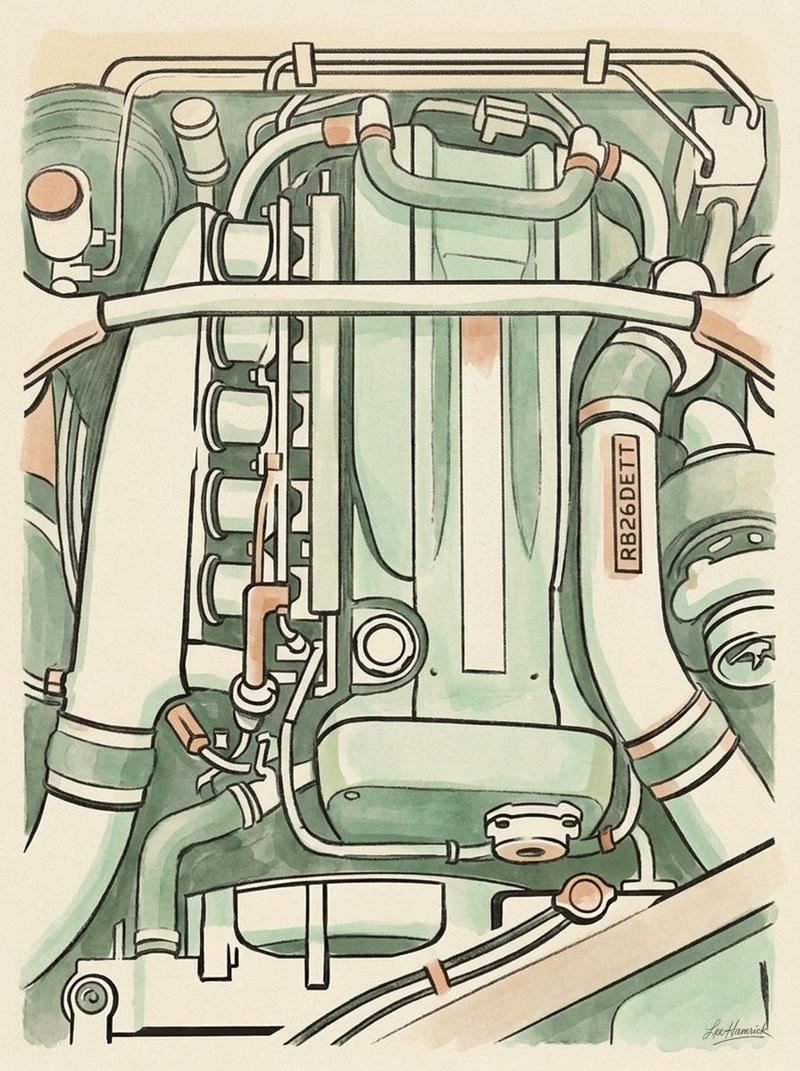
The RB26DETT is the engine that built the GT-R's legend. It is a cast-iron-block inline-six with individual throttle bodies, a stock bottom end with cast pistons, and a history of supporting very large power numbers on proper builds. The factory twin turbo setup is functional but it is also a known maintenance item, and most serious builders replace or upgrade it as part of the build.
What makes the RB26 compelling as a build platform:
- The bottom end is strong in stock form and genuinely capable of handling significant boost on fresh internals
- Aftermarket support is extensive, with decades of documented builds to reference
- The individual throttle body setup rewards tuning and responds well to modern engine management
- Parts availability, while not cheap, is not the problem it is on more obscure Japanese platforms
What to watch for on a used example: oil consumption, coolant intrusion, and turbo seals. A compression test and a leak-down test before purchase will tell you a lot. If the seller will not let you do that, walk.
The Build Path: Where the Money Actually Goes
A lot of people think about power first. That is not where to start.
The GT-R's ATTESA E-TS all-wheel drive system and HICAS four-wheel steering are complex, and both need to be in sorted condition before you add power. The transfer case, the rear differential, the front differential. If any of those components are worn or leaking, get them right first. Adding power to a drivetrain that is not healthy is how you turn a $5,000 problem into a $15,000 problem.
After the drivetrain is sorted, brakes. The V-Spec II Brembo setup is a legitimate platform to work from. If you are on a standard car, upgrading the braking system before chasing power numbers is not optional, it is responsible.
Then suspension. The factory setup is dated by modern standards. A quality coilover setup with proper alignment is going to transform how the car drives before you ever touch the engine.
Power: Be Honest About What You Are Building
The RB26 responds well to turbos, fuel, and engine management. A modest single or twin turbo upgrade with supporting fueling and a proper tune can push reliable power numbers that will feel transformative in a car that weighs around 3,400 pounds.
The highest-horsepower builds, the four-digit stuff you see in videos, require fully built engines, custom everything, and tuners who specialize specifically in RB builds. They are impressive and they are expensive and they are not what most people should be building. A well-executed 500 to 600 horsepower street build on a sorted chassis will be faster in the real world than an over-built 1,000 horsepower car on a neglected drivetrain.
The builds worth referencing:
- Single turbo conversions using well-supported kits with proper manifold and exhaust work
- Modern engine management replacing the factory ECU for better tuning resolution
- Upgraded fueling to match whatever turbo target you have set
- A proper dyno tune from someone who has actually done RB26s before
The tune is not the last step. It is the last step only after everything else is correct.
The Bayside Blue Question
Bayside Blue is the color most people picture when they picture the R34 GT-R. It is also one of the most replicated, mis-stated, and paint-matched colors on the resale market. If originality matters to you, document it. If it does not, at least know what you are buying.
Color affects value, but a driver-quality example in another color that is mechanically correct will almost always be a better build foundation than an overpriced, paint-corrected Bayside car with unknowns underneath.
What the Insurance Data Actually Says
Collector and specialty vehicle insurance on a car like the R34 is not straightforward. Agreed value policies exist and they matter here because the market value on these cars can move faster than an actual cash value policy will keep up with. If you are building up the car, you need to be updating your coverage to reflect the build value, not just the acquisition price.
Repair costs on R34 GT-Rs in the US market are high. Specialist labor is expensive, OEM parts require importation in many cases, and body panels are not something you source at a local pick-a-part. This is not a reason not to build one. It is a reason to build one correctly and to carry insurance that actually reflects what you have in the car.
Total Cost Reality Check
A base R34 GT-R import, compliance, and delivery is not a cheap starting point. Add a serious drivetrain refresh, a quality suspension setup, a brake upgrade, and a responsible power build with a proper tune, and you are talking about a project where the total investment can exceed the car's current retail market value before the build is finished.
That is fine if you know it going in. It is a problem if you discover it at step four.
The builds that hold value and actually get driven are the ones with documentation, clean execution, and known components. Receipts matter. A sorted, well-documented R34 with a reasonable power level and clean history is worth more to a future buyer than a mystery build with big claims and no paper trail.
This is the deal right now: R34 GT-Rs are still accessible if you move thoughtfully, but the window is not wide and the good examples are thinning out. Build it right, document everything, and drive it. That is the whole point. For more on the GT-R's broader legacy and the aftermarket ecosystem it created, see The Legacy of the Nissan GT-R: How It Shaped the Automotive Industry and Aftermarket.

Written by
Zach Bronstein