Lucid's $1.47B Inventory Collapse Proves Luxury-Only EV Strategy Is Broken

Lucid's massive unsold inventory and software failures reveal why betting exclusively on ultra-premium EVs without bulletproof execution is a path to bankruptcy
Lucid has roughly $1.47 billion in unsold inventory sitting in lots, and the CEO just hit pause on production. That number isn't a quarterly hiccup. It's an admission that the entire bet was wrong.
The company staked everything on selling $110k+ sedans to wealthy EV adopters who supposedly couldn't wait to abandon Tesla and Mercedes. The math made sense on a spreadsheet: premium pricing, limited production, wealthy early adopters. Lucid would be the thinking person's luxury EV brand.
The problem is that thinking people actually checked the software quality first.
The Execution Gap Nobody Talks About
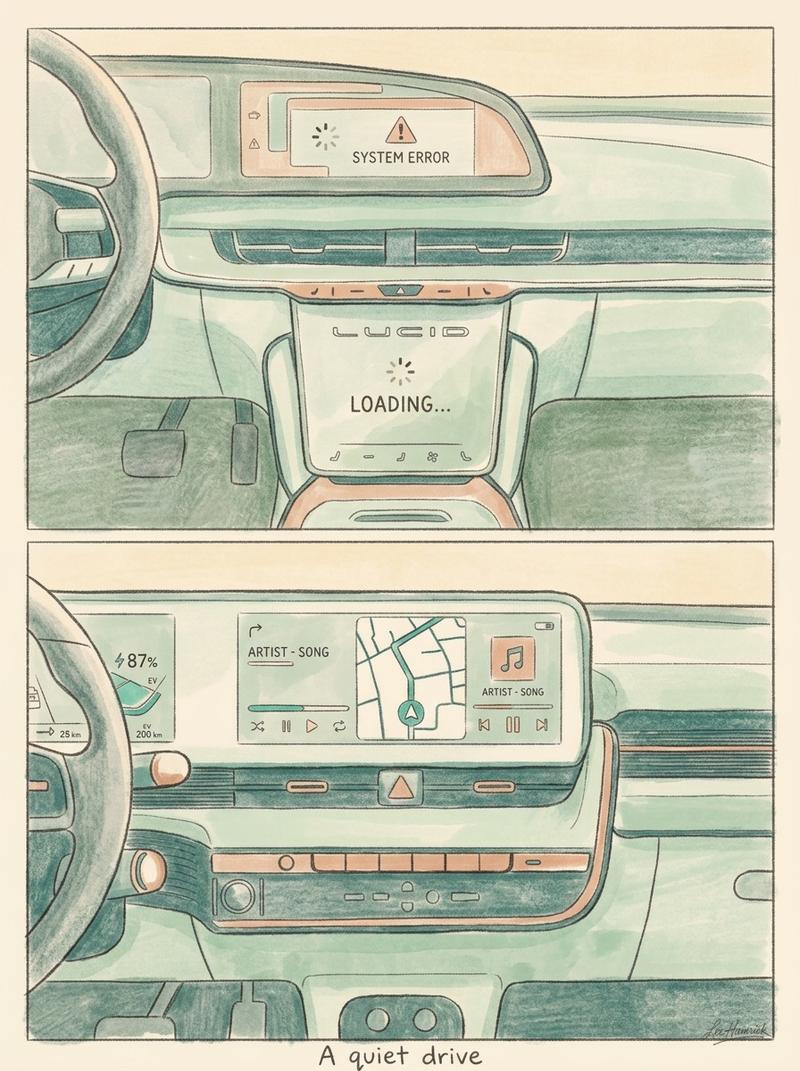
You can price a car at $110k and move volume if the product is flawless. Tesla proved that with the Model S. But Lucid owners report non-functional key fobs, buggy autonomous features that require constant service visits, and infotainment systems that feel three generations behind what Hyundai ships on a Ioniq 5.
That's the real killer. Not the price point. Not the market segment. The fact that when someone spends six figures on your car, the basic electrical architecture doesn't work reliably.
Multiple YouTube reviewers and owners have documented these issues with receipts. Not nitpicks. Critical reliability failures that make the ownership experience worse than a $45k EV from Kia. The gap between "luxury" positioning and actual quality is so wide that no amount of leather and horsepower bridges it.
If Lucid dropped the Sapphire to $70k tomorrow, would it sell better? Maybe. Would it sell significantly better if the software still fails? No. The inventory would just sit longer.
The Broader Market Miscalculation
Lucid's strategy wasn't unique. It was shared by every EV startup except Tesla: chase the wealthy first, achieve volume later.
The assumption was sound in theory: rich buyers are less price-sensitive, early adopters are willing to overlook teething problems, premium margins fund growth.
What actually happened is that wealthy buyers already have access to established luxury brands. And they picked Porsche, BMW, Audi, and Mercedes because those companies have dealerships, service networks, and decades of reliability data.
Meanwhile, the middle market (where 90% of car sales actually happen) got systematically ignored. Kia and Hyundai figured out that a $45k Ioniq 5 outsells a $110k startup sedan because it actually exists on dealer lots, charges fast, and doesn't require a trip to the service bay every month.
Lucid bet on a segment that doesn't move volume. Tesla moved volume because the Model 3 started at $45k and delivered genuine technology advantage plus reliability. Every other premium EV startup assumed they could skip the hard part: making a product so good that people choose it over cheaper alternatives.
Why Software Issues Kill Premium Brands Faster
A $35k EV with buggy software is annoying. You paid for affordable transit.
A $110k EV with buggy software feels like fraud. You explicitly paid for premium engineering. The disconnect between price and experience is so obvious that owners broadcast it on social media, YouTube, and car forums.
Lucid's software problems aren't different in kind from what other manufacturers deal with. They're fatal in magnitude because the premium positioning makes every flaw visible and inexcusable. You can't charge $110k and claim luxury engineering if your key fob doesn't work.
That's why the inventory is rotting. Not because the market doesn't want premium EVs. Because the market doesn't want premium-priced cars with mid-tier execution.

The Volume Problem Nobody Solved
There's a hard truth buried in this disaster: new EV brands cannot compete with Tesla's Model 3 or Y at the mass market, and they cannot compete with Cadillac, Hyundai, and Kia at the premium end.
Tesla owns the affordable EV space through sheer scale and proven reliability. Kia and Hyundai own the sub-$60k premium space because they have manufacturing expertise, service networks, and no brand perception issues. Porsche owns the $80k plus segment because Porsche.
Where does that leave Lucid? In a gap that doesn't actually exist. There's no profitable segment at $100k for a startup brand with execution problems. The wealthy buyers who actually spend six figures on cars are not risk-takers when it comes to unproven brands. They want the German nameplate or the Tesla brand equity or the Porsche legacy.
Lucid's strategy assumed it could buy its way into that space with design and performance. Instead it discovered that premium positioning requires premium execution across every surface: hardware, software, service, ownership experience, and brand reputation. Lucid has nailed maybe two of those five.
The Data Doesn't Support The Narrative
The inventory number is the real metric. $1.47 billion in unsold cars means the market has already voted. It doesn't matter what Lucid's product roadmap says or what the CEO promises. Wealthy EV buyers chose other brands.
This isn't a supply problem. It's not a marketing problem. It's a product-market fit problem. Lucid built a car for a customer that doesn't exist in the volume required to sustain the business.
Every luxury EV startup is now facing the same hard math. You can chase the wealthy, but only if you execute like Porsche. You can chase volume, but only if you price like Hyundai and deliver like Tesla. You cannot split the difference and expect to survive.
Lucid tried to split the difference. The $1.47 billion in inventory is what that looks like.

Written by
Ben Eckels