Porsche's Transaxle Experiment Turns 50: The Cars That Nearly Killed the 911

The Porsche 924 launched 50 years ago and started a transaxle lineage spanning the 944, 968, and 928. Here's why these cars still matter to enthusiasts.
In 1976, Porsche, a company whose entire identity was built on a rear-mounted flat-six, introduced a front-engined sports car with the transmission bolted to the rear axle. That car was the 924, and it started a lineage that lasted nearly two decades, spawned some of the most driver-focused Porsches ever built, and almost replaced the 911 entirely. Almost.
The 924 did not begin as a Porsche. It started as Volkswagen project EA425, designed on what engineer Harm Lagaay described as a literal white sheet of paper. VW pulled out as the oil crisis deepened, favoring the Golf-based Scirocco instead. Porsche bought the project back, and the key thing that made them want it was the transaxle layout itself.
Here is what the transaxle actually does: instead of bolting the gearbox directly to the engine up front and running a driveshaft all the way to a conventional rear differential, you move the entire transmission to the rear axle. The engine still lives up front, but the gearbox mass migrates rearward. The result is a front-to-rear weight distribution that no conventional front-engine car can touch without a lot of expensive engineering gymnastics. This is not a marketing concept. It is a measurable mechanical advantage.
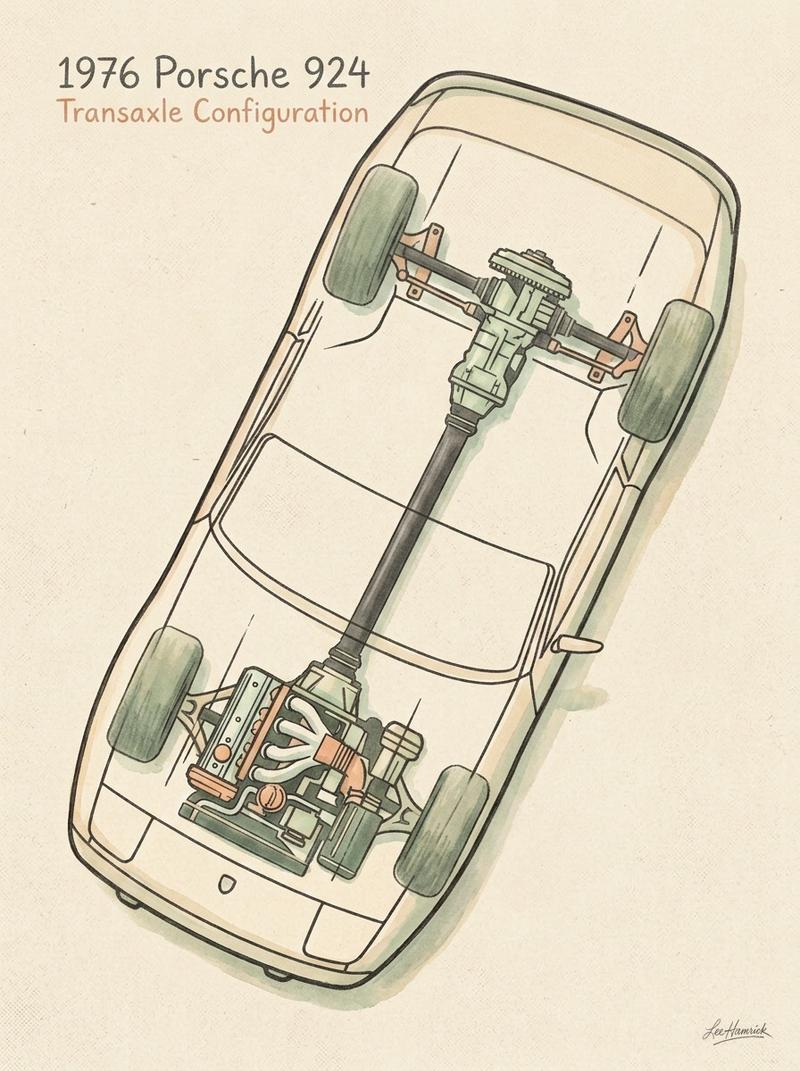
Roland Kussmaul, who was a road-testing engineer on these cars, called the 924 "easy-to-handle, forgiving, fast." That is not a coincidence. That is weight distribution doing exactly what physics says it should do.
Porsche Chairman Ernst Fuhrmann believed the transaxle cars, and specifically the 928, would eventually replace the 911. He was wrong about the market, but he was not wrong about the engineering. The customers kept buying 911s anyway. The 911 survived. The transaxle line did not, ending production in 1995 with the 968.
But here is what the used-car market still has not fully priced in: these four cars are genuinely excellent, they are significantly cheaper than any air-cooled Porsche, and the engineering case for them is airtight. Let me run through each one.
1977-1988 Porsche 924
The 924 landed in the US a year after its European debut, initially with 95 hp from its Audi-developed 2.0-liter four-cylinder and, at first, only an automatic transmission. That combination is not the one you want. The car eventually got a 110 hp output bump and, more importantly, a dog-leg five-speed manual. Get the manual.
The Turbo variants pushed past 140 hp, and the homologation-special Carrera GT broke 200 hp. Those are the headline grabbers, but the last-of-the-line 924S is probably the most rational buy in the lineup: it carries the 944's more refined 2.5-liter engine in the lighter 924 body. Over 150,000 were built, so supply is not a problem.
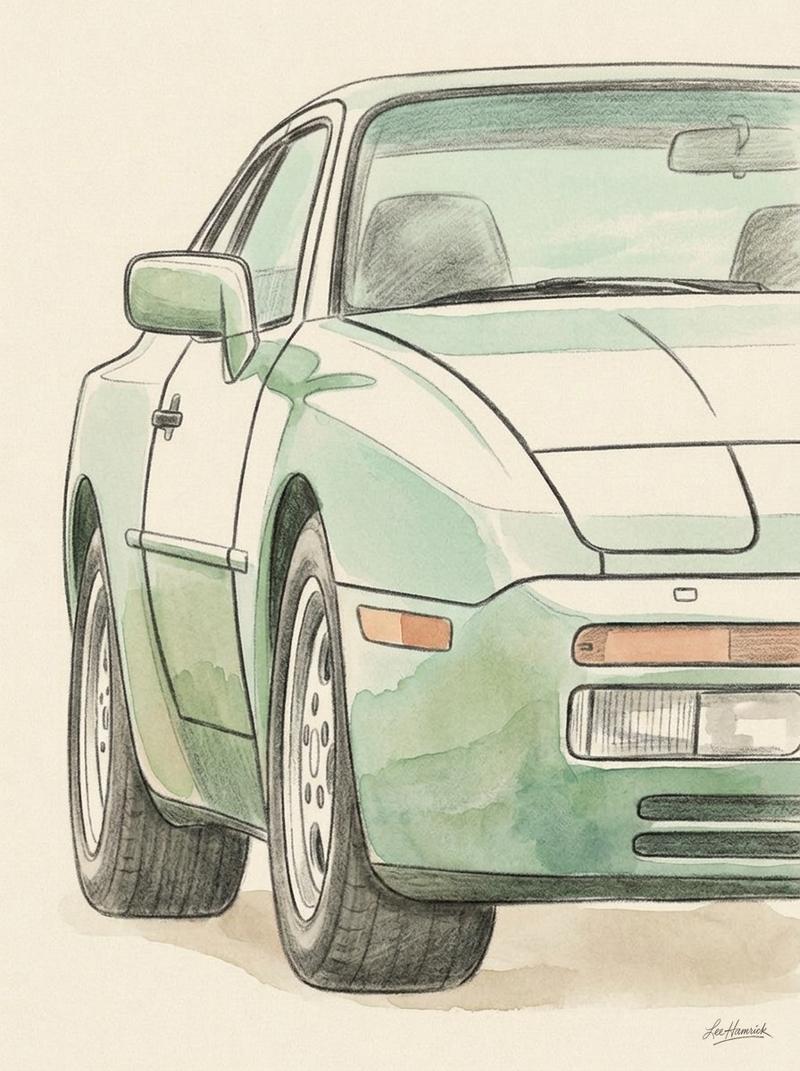
1981-1991 Porsche 944
The 944 is where the transaxle concept fully arrived. The 2.5-liter inline-four was effectively one cylinder bank of the 928's V8, and it made 143 hp in base form. The Turbo versions eventually exceeded 220 hp. By the end of the production run, the engine had grown to 3.0 liters, which made it the largest-displacement inline-four on sale at the time.
The 944 has a wider track than the 924, flared fenders, and a chassis that rewards commitment. The cabriolet exists, but the open-top version trades away a meaningful amount of chassis rigidity in exchange for fresh air, and that trade dulls the driving experience. Buy the coupe. More than 160,000 were sold, and good examples are not hard to find.
1977-1995 Porsche 928
The 928 is the wild card. Porsche's first production V8, offered in 4.5-liter form with 219 hp at launch, eventually grew through 4.7-, 5.0-, and 5.4-liter versions before ending its run as the GTS with 345 hp. Kussmaul noted that a rear-engine layout was never even considered for the 928 given the size and weight of that V8, which is exactly why the transaxle made so much sense here. You had to offset that front mass somehow.
The pick of the 928 range is the S4 built from 1987 to 1991, with 316 hp from five liters, available with a five-speed dog-leg manual or a four-speed automatic. The S4 is the version that best balances the 928's grand touring ambitions with actual driver engagement. It is a big car, but the weight is managed well enough that it still earns its Porsche badge on a canyon road.
1992-1995 Porsche 968
Only 12,780 were built. That number alone tells you something about the 968's position in the market, and it also tells you something about its future value trajectory. The 968 took the 944's platform, reworked the bodywork significantly with a nose that referenced both the 911 and 928, redid the interior, and dropped in a 3.0-liter inline-four with VarioCam variable valve timing producing 236 hp. The standard gearbox was a six-speed manual. Tiptronic was an option. Do not choose the Tiptronic.
The Club Sport variant stripped weight and deleted the rear seats entirely. If you find one, it is the best driver's car of the entire transaxle generation, no argument. The 968 was picked as a buy on Hagerty's 2022 Bull Market list, and owners who actually drive them know why. It is the most sorted, most modern-feeling of the four, and it is still the cheapest way into a front-engine Porsche with a real manual gearbox and a chassis that was engineered to be driven.
The Verdict, Ranked
- Best driver's car: 1992-1995 Porsche 968 Club Sport. Most focused, rarest, best chassis of the group.
- Best value entry point: 1981-1991 Porsche 944. Parts availability, community support, and enough performance to justify every dollar.
- Best touring machine: 1987-1991 Porsche 928 S4 with the five-speed manual. Big, fast, and properly sorted.
- Best project starting point: 1977-1988 Porsche 924. The 944 engine in the lighter body, and there are enough of them around that buying a rough one to build is not a gamble.
Porsche Chairman Fuhrmann thought the transaxle would replace the 911. He was wrong about that. But the engineering logic behind these cars was correct, and the proof is in how well they still drive fifty years later. The 911 survived because customers wanted the 911. That does not mean these cars lost. It means they were built for a different kind of driver, and that driver is still out there, just now paying a lot less than a comparable air-cooled car would cost.
I ran the numbers on acquisition cost versus driver engagement per dollar, and it is not even close. The transaxle cars win that comparison every time.

Written by
Ben Eckels