The Toyota MR2: A Sports Car That Trusted You to Know What You Were Doing

The Toyota MR2 was Japan's first mid-engine mass-production car. Here's why its honest, lightweight formula still matters to driving enthusiasts.
I remember the first time I sat in a car with the engine behind me. It wasn't an MR2, but the principle was the same, and what stuck with me wasn't the novelty of it. It was the honesty.
There's a particular kind of directness that comes from a mid-engine layout, especially one mounted in something as purposefully light as the Toyota MR2. You can feel where the weight is. You can feel what the rear tires are doing. And when you make a mistake, the car doesn't hide it from you behind layers of electronic intervention. It tells you exactly what went wrong, and it does so immediately.
The MR2, across its generations, was never a car designed to protect you from yourself. It was designed to reward the person who understood its quirks and punish the one who didn't. That's a specific kind of appeal, and it explains why these cars have held a grip on enthusiasts for nearly four decades.
What Made It Different
When Toyota launched the first-generation MR2 in 1985, mid-engine layout was not mainstream. It was exotic. It belonged in Ferraris and Lamborghinis, not in a car that cost less than half as much as a base Mercedes sedan. The MR2 was Japan's first mid-engine mass-production car, and Toyota knew what they were doing with the positioning. The Fiat X1/9 had proven a budget mid-engine sports car could find buyers; Toyota's answer was to build one that was more reliable, more refined, and available through a dealer network people actually trusted. That alone was bold, but the real statement was in the execution.
The original MR2 was light. Properly light. The first-generation car with the 4A-GE 1.6-liter engine weighed approximately 2,094 lbs (950 kg) in base form, depending on trim and market. By comparison, the 2023 Mazda MX-5 Miata, often cited as the modern answer to the MR2's formula, starts at around 2,341 lbs. The MR2 did it better, decades earlier, and it did so without power steering, without ABS, without a single electronic nanny telling the driver to slow down.
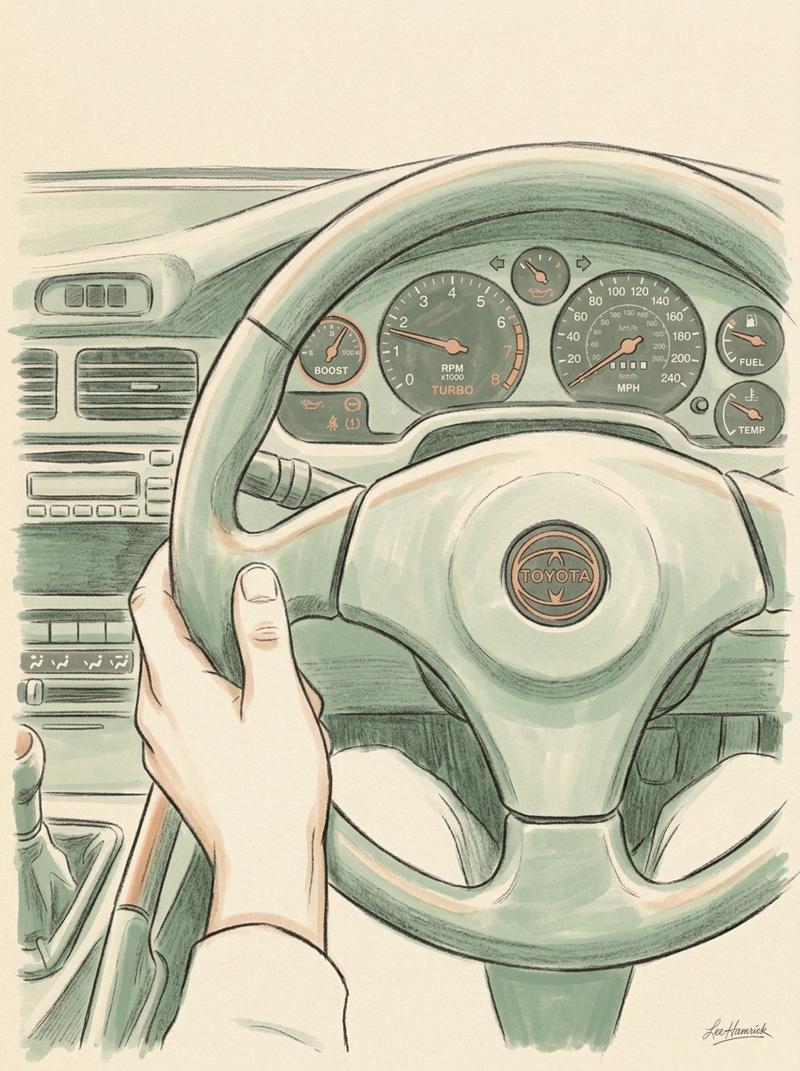
Part of how Toyota got there was packaging. A mid-engine layout moves mass inboard and away from the extreme ends of the car, which means less structure is needed to support the drivetrain at the nose or tail. The tradeoffs are real: storage space is minimal, the engine bay is cramped, and servicing certain components requires patience. But the payoff in weight distribution and steering feel justified every one of those compromises. The 4A-GE produced 112 horsepower in U.S. trim, and in a car that light, 112 horsepower is more than enough to hold your attention.
The result was a car that felt alive in a way most modern sports cars, even good ones, don't. There was real steering feedback. Road texture wasn't just a sensation, it was information. The engine note, sitting inches behind your head, was immediate and visceral. And the handling, especially as you learned the car's limits and then pushed beyond them a little, was something between terrifying and addictive.
The car won the 1984 Car of the Year award in Japan. That's not a footnote. A purpose-built mid-engine sports car, voted car of the year in its home market, against the full field of what was being sold at the time. The market understood what Toyota had done.
The second-generation MR2, which arrived in 1991 and ran through 1999, got heavier and more powerful, but it also got better suspension, better ergonomics, and a turbocharged variant that made real power. But it was still fundamentally un-assisted in the way that mattered. You steered it yourself. You managed the throttle yourself. The car expected you to be paying attention. Toyota also offered a supercharged variant on the first generation in certain markets, which kept the naturally aspirated character while adding a meaningful bump in output, a different answer to the same question the turbo second-gen was asking.
The third generation landed in 1999. It was smaller, lighter, and softer in character than the second-gen, built for a market that was shifting its expectations. What the third generation stood for philosophically, and how it handled the compromises of a changing regulatory and commercial environment, is not something I can reconstruct without better sourcing than I have in front of me. What the production record shows is that Toyota kept the mid-engine, rear-wheel-drive formula alive through a decade that didn't reward that decision commercially. That counts for something.
The Feel of the Thing
I've owned sports cars from most eras, and what separates the ones I remember from the ones I forgot is simple: the way they felt to drive. Everything else, you can measure on a dyno or read in a spec sheet. But the feeling, the feedback loop between your hands and feet and the machine below you, that's what you actually own after the purchase is done.
The MR2 nailed that in a way that a lot of more expensive, more powerful cars didn't. The mid-engine layout centralizes the heaviest mass, the engine and transmission, close to the car's center of gravity. That reduces the polar moment of inertia, which is the resistance a car has to rotating around its vertical axis. Less resistance means the car responds faster to steering inputs and transitions more quickly between states. It also means mistakes happen faster. The same quality that makes the car feel alive and responsive is the quality that makes it unforgiving when you're wrong.
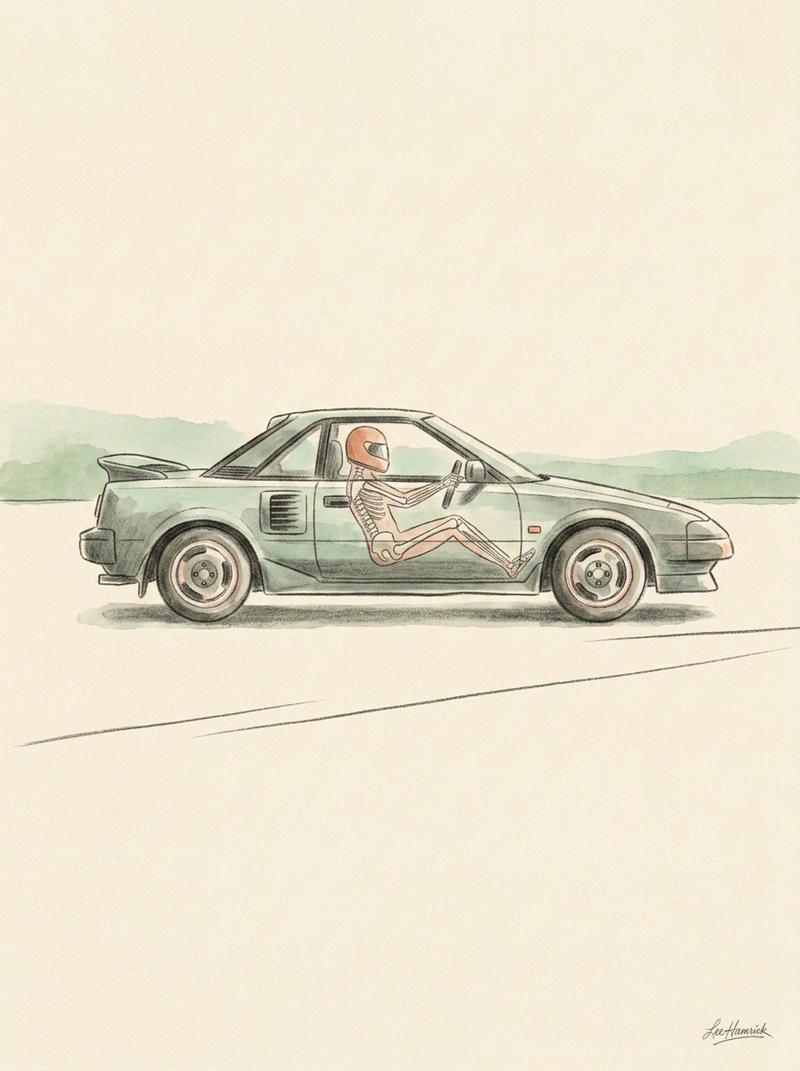
Front-engine, rear-wheel-drive sports cars have a particular kind of weight distribution that tends toward oversteer at the limit, with a moment of lag before you can correct it because the mass is out ahead of you. Mid-engine cars have the weight more centralized, which produces more neutral balance and faster yaw response. Add in light weight, and you've got a car that rewards smooth inputs and punishes sloppiness, but in a way that feels fair. The car tells you what it's about to do. Whether you act on that information in time is your problem.
The steering, especially in the earlier generations, was unassisted and direct. No virtual centering, no electronic dampening. Just you, the steering column, and the road. On a day when everything clicks, when you're warm and focused and the road is smooth, that kind of steering is poetry. On a day when you're tired or distracted, it's work. That's the contract the MR2 made with its driver, and I think the car benefited from a market that was still willing to sign that kind of agreement.
The Wrinkle in the Formula
For all the MR2's strengths, it had a genuine weakness that no amount of driver skill could completely overcome. Mid-engine, rear-wheel-drive cars have a particular kind of oversteer characteristic. When you push them too far, when weight transfer gets ahead of your inputs, the rear wants to come around. In a light car with a lot of grip, you can catch it. Usually. But if you can't, if you're a fraction too slow or the tire has one degree less grip than you expected, the car can transition from entertainer to nightmare very quickly.
This isn't a flaw, exactly. It's an honest consequence of the layout and the philosophy. A driver who respects the car, who understands what mid-engine means and who's willing to put in the work to learn it, will be faster and safer in an MR2 than in a more forgiving car. But a driver who's overconfident, or unlucky, or just having one of those days, can find themselves in real trouble very quickly. The car doesn't have electronic stability control to intervene. It doesn't have power steering to help catch a slide. It has feedback and physics and the assumption that the person in the seat knows what they're doing.
That was probably part of the appeal, actually. The MR2 was never going to be a car for everyone. It was a car for people who wanted to actually drive, who saw traffic and commutes and road trips not as obstacles but as opportunities to engage with the machine. That's a smaller group now than it was in 1985, but the fact that the cars still command decent prices on the used market, that they still show up at track days and autocrosses, suggests the group hasn't disappeared entirely.
What It Meant, and What It Still Does
The MR2 exists in a peculiar place in automotive history. It's not old enough to be a true classic, not modern enough to have the technology that some people now consider essential, and not exotic enough to exist purely as a collector piece. It's just a sports car, a proper one, from an era when sports cars didn't assume you needed electronic assistance to stay safe.
That makes it valuable in a way that goes beyond depreciation curves and market value. It's proof that lightweight, responsive, mid-engine sports cars work, that they're fun, that they don't need a thousand horses or a million-dollar suspension to be engaging. They just need to be honest about what they are.
Every generation of MR2 deserves its place in the conversation. The first one proved the concept could work at an accessible price point, won a Car of the Year award doing it, and established that Japan could build a mid-engine sports car that didn't require a Ferrari budget to maintain. The second one made it fast and more livable. The third tried to keep the formula alive in a world that was changing rapidly around it. None of them coddled the driver, and all of them are better for it.
That kind of car is getting harder to find. Not impossible, but harder. And maybe that's okay. Not every person wants to drive a car that requires genuine skill and attention. But for the ones who do, who miss the days when sports cars trusted you to know what you were doing, the MR2 is a reminder that those days were real, and that the lessons they taught still hold.

Written by
Lee Hamrick