The Tyrrell P34: Why Six Wheels Made Perfect Sense (And Why Nobody Tried It Again)
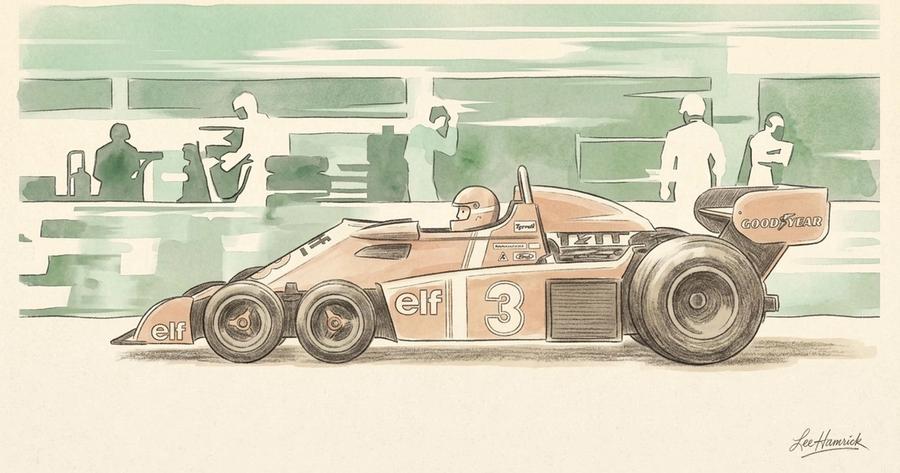
The Tyrrell P34 wasn't a gimmick. It was a carefully engineered solution to a real problem in 1976 Formula 1, backed by data and desperation.
In 1976, Ken Tyrrell's team arrived at races with a car that looked like someone had bolted four wheels to a chassis and forgotten to ask if they should. The Tyrrell P34 had six wheels: two in front, four in back. It was strange enough that people remember it as a novelty. In truth, it was an engineering answer to a constraint most Formula 1 teams faced and nobody else had the audacity to solve.
The problem was simple: bigger tires meant more grip, but F1's regulations at the time allowed only four contact patches. Teams were locked in an escalating war over tire width and sidewall stiffness. Michelin was pushing the boundaries. Cooper and others were pushing back. Everyone was stuck running tires at the edge of what was legal and sensible, and everyone was running out of options.
Ken Tyrrell and his engineer Derek Gardner looked at the rule book. It didn't say you had to have four wheels. It said you had to have a certain minimum track width and specified tire dimensions for a "wheel". Nowhere did it mandate the total number.
So they built a car with 10-inch front wheels (half the diameter of the rears) and paired rear tires. The front wheels were narrower, lighter, lower-rolling-resistance contact patches. The rears handled the lateral loads where it mattered. On paper, you got the tire contact patch you needed for grip without triggering a restriction war.
The Math Actually Worked
Most people assume the P34 was experimental fantasy that happened to show up in races. The data says otherwise. In 1976, the car won the Swedish Grand Prix. Jody Scheckter posted competitive qualifying times. The car was faster in certain conditions, particularly on high-downforce circuits where the narrower front end reduced drag while maintaining cornering stiffness.
The real limitation wasn't engineering. It was tire supply. Michelin had to develop smaller front tires specifically for Tyrrell. That meant custom tooling, custom compounds, custom testing. For a constructor that had roughly three races' worth of budget advantage, it was expensive. For Michelin, supporting a one-off customer with a non-standard configuration was a headache that didn't pay off across their line.
More importantly, once the FIA caught on to what Tyrrell had actually done, they moved fast. By 1977, the regulations were rewritten to explicitly require four wheels. The governing body didn't ban it because it was slow or dangerous. They banned it because other teams would have had to do it too, and that meant further engineering fragmentation. Formula 1 prefers a level playing field, even if the field is slower.
Why Nobody Else Tried It
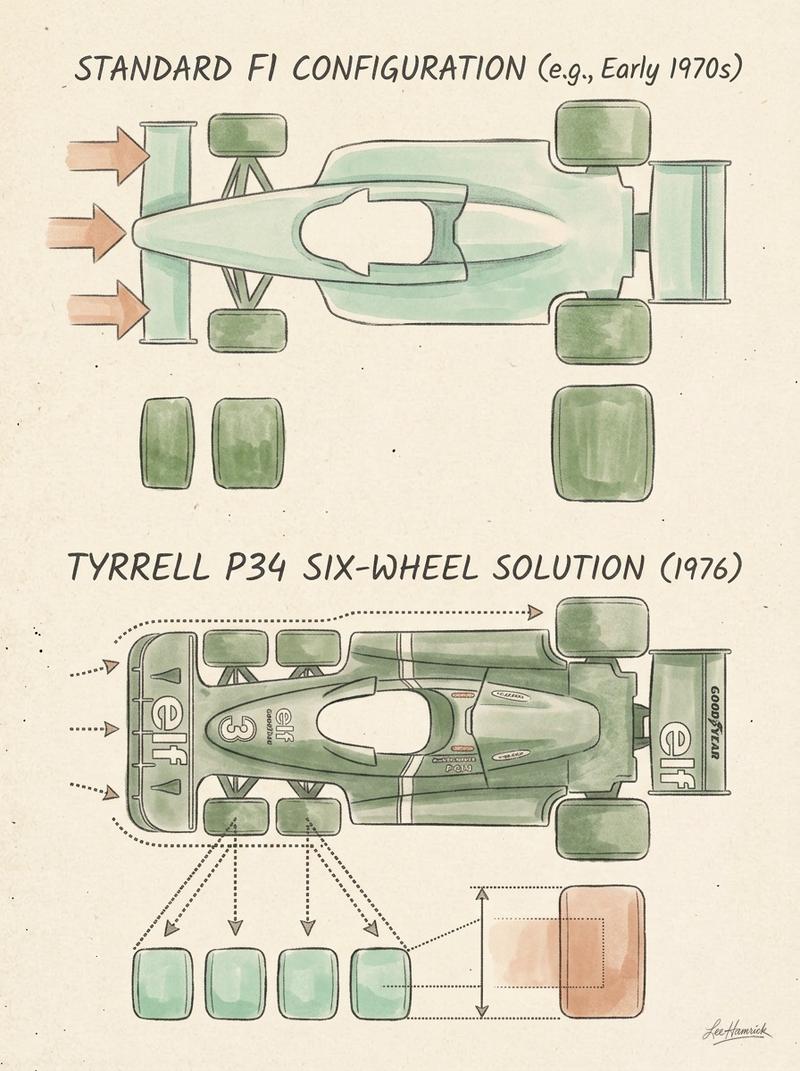
The obvious answer is that the rules closed. But the deeper answer is that six wheels were a tactical hack, not a strategic advantage. You could only get the benefit if you were willing to absorb the development cost while everyone else ran standard configurations. For a mid-grid team with limited resources, six wheels was exactly the kind of expensive differentiation that ate up your budget without guaranteeing results.
Consider the dynamics from a competitive standpoint. Tyrrell gained maybe a tenth of a second in specific conditions. But they lost ground in other areas: tire degradation characteristics were different, brake cooling was affected by the different geometry, and the car's weight distribution was unlike anything else on the grid. Engineers had to relearn how to set it up race by race.
After the ban, nobody pushed back. Not Tyrrell, not any other team. Because six wheels solved a regulatory squeeze that existed for maybe 18 months. Once that problem was solved by explicit rule changes, there was no reason to revisit it.
The Actual Legacy
The P34 is remembered as the crazy six-wheeled car that someone built in the 1970s. But its real significance is simpler: it's proof that the best engineering solution and the best competitive solution are not the same thing. Derek Gardner engineered something that worked. Ken Tyrrell implemented it. The FIA killed it, and the sport moved on.
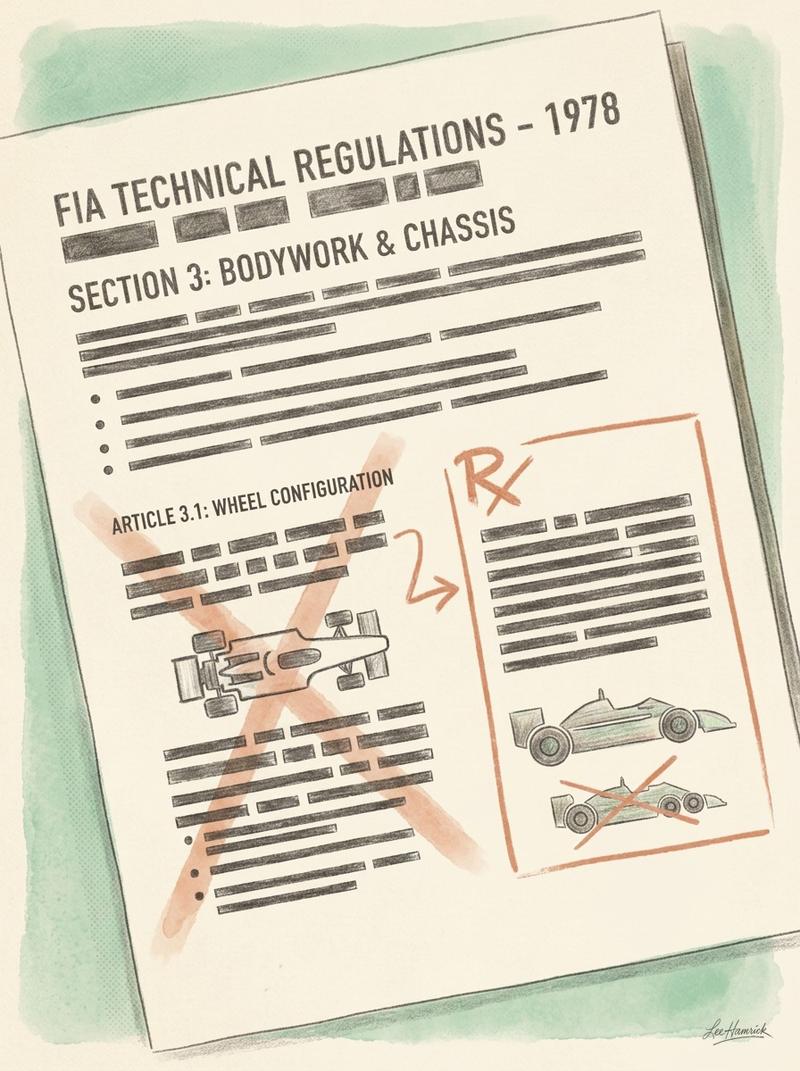
What's interesting now, looking back, is that nobody in Formula 1 spent much time asking whether the ban was right. Teams didn't lobby to keep six-wheelers legal. Drivers didn't complain that they'd been robbed of a faster car. It was interesting, it was clever, and it was gone. The sport replaced it with a different set of rules that produced different problems, and teams got on with solving those instead.
The P34 shows something about how motorsport engineering really works. It's not about finding the perfect solution. It's about finding the legal solution that your rivals didn't think of first, squeezing whatever advantage you can get from it, and knowing when it's time to move on to the next thing. Tyrrell did that. The rule book caught up. Everyone learned.
If you built it today, you'd hit a rule ban in six months and spend three years in FIA committees explaining why it should be allowed. In 1976, you just built it, raced it, and saw what happened. Sometimes that's how the good engineering happens.