This Is Not Normal Racing

Endurance racing, hillclimbs, and ice rallies share a track with mainstream motorsport but operate by completely different rules. Here's why that matters.
There's a moment at most track days where someone lines up next to you at the start of a session, and you can tell just by looking at their car that you two are not doing the same thing. Same pavement, same corner radii, same flaggers in the same vests. But whatever they're attempting and whatever you're attempting are separated by something harder to name than speed. I think about that feeling a lot when I try to explain to people why I find certain corners of motorsport so much more interesting than the headline series.
Not better, necessarily. Just different in a way that matters. The kind of different that makes you rethink what racing actually is, once you start pulling at the thread.
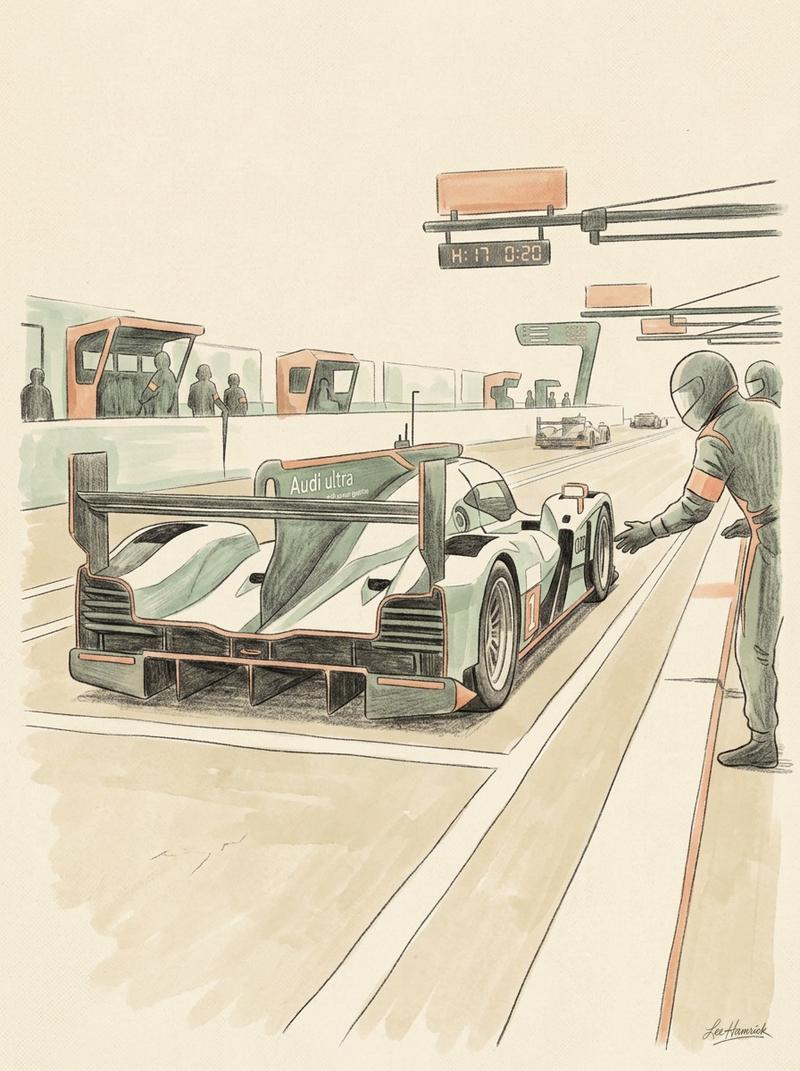
Take endurance racing as a starting point, because it's the most visible example of motorsport where the objective quietly stops being "go fastest" and becomes something stranger and more interesting. The basic tension of an endurance race is that you cannot actually drive as fast as the car is capable of going for the entire event. The machinery, the tires, the fuel load, the driver's own biology, the probability of something breaking at an inopportune moment. All of it conspires to make pure speed almost beside the point. What you're managing instead is the rate at which you consume your own resources against the rate at which everyone else consumes theirs. It's closer to systems thinking than it is to racing in the instinctive sense.
That's not a knock on it. If anything it raises the cognitive load in a direction that I find genuinely compelling. A driver in a sprint race is solving a narrow, high-intensity problem for a defined window of time. A driver in a long-distance endurance event is solving a probabilistic problem that keeps changing shape under them for hours. The decisions compound. The margin for a single bad call gets wider as the event goes on. I spent way too long thinking about why endurance racing felt so different to watch and that was the conclusion I landed on, more or less.
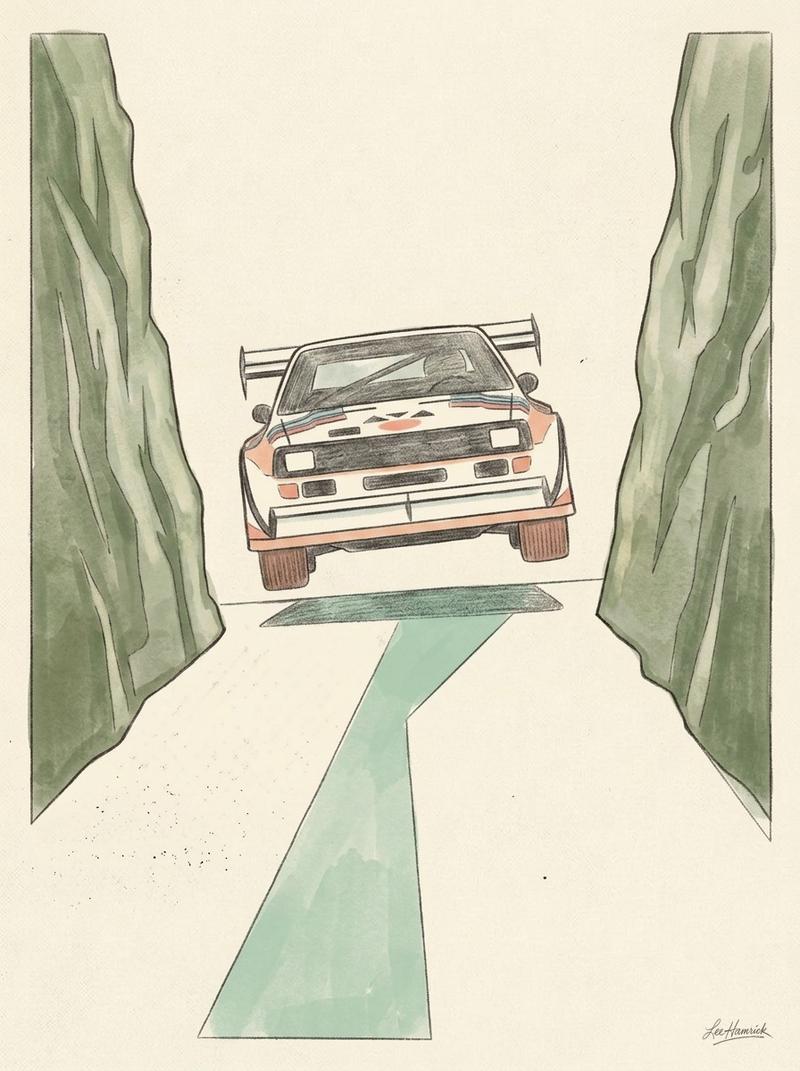
Hillclimb is somewhere else entirely on the map. You could argue that a hillclimb is the purest possible distillation of motorsport: one car, one driver, one road, one run. No opponent in the traditional sense. No pit wall strategy, no safety car restarts, no tire delta calculations. Just the clock and the mountain. But the thing that makes it genuinely strange compared to circuit racing is that the driver almost never has a complete picture of what they're driving into. A circuit can be memorized. Every sector, every brake marker, every apex. A hillclimb road changes. Grip levels vary from pass to pass. Conditions shift mid-run. There are blind crests where the driver has to commit to a line before they can see whether the road confirms their guess.
That's a fundamentally different trust relationship between driver and car than circuit racing asks for. And the cars themselves can be genuinely bizarre as a result: low production numbers, purpose-built around specific gradient and surface conditions, often with power-to-weight ratios that make more famous machinery look pedestrian. They don't need to work anywhere else. They just need to work here, on this road, on this day.
Ice rallying occupies a corner of the calendar that I think most enthusiasts on this side of the world underestimate. Not because it's obscure, but because the skill set it demands is so different from tarmac driving that it almost needs its own vocabulary. The grip levels are so low and so variable that the car is almost always operating in a controlled state of chassis displacement. You're not fighting the oversteer so much as you're steering with it, using the rear's willingness to rotate as part of the basic vocabulary of the corner. The driver isn't trying to find the limit in the conventional sense because the limit is vague and it moves around and sometimes it simply isn't there.
What strikes me about watching really good ice rally drivers is that they seem less reactive than tarmac drivers and more anticipatory. They're not correcting the car's behavior, they're predicting it several steps ahead and placing the car where the slide will resolve rather than where it started. I'm not sure I can actually do that. I know I can't do it at speed on ice. But watching someone who can is a useful reminder that car control as a skill is not one thing.
There's a broader point underneath all of this that I keep circling back to. Normal racing, meaning primarily closed-circuit sprint or championship-format events on permanent or semi-permanent tracks, selects for a particular kind of excellence. Consistency over short windows, precision under defined and repeatable conditions, the ability to manage tire temperatures and fuel loads within a narrow bandwidth. That's real and it's hard. But it's also only one slice of what driving a car well actually means.
The formats I've been describing select for different things. Endurance selects for management of uncertainty and fatigue. Hillclimb selects for commitment and spatial memory under incomplete information. Ice rallying selects for proprioception and predictive chassis feel at the edge of available grip. These aren't lesser skills. They're orthogonal skills. And the cars built to express them end up looking and behaving like nothing else in motorsport because they don't need to satisfy any brief except the one their specific event demands.
I think that's why I keep coming back to them. The cars are weird and specific in ways that reward attention. The driving is hard in ways that don't necessarily translate across disciplines. And the whole enterprise keeps reminding me that "fast" is a context-dependent word, which is probably the most useful thing motorsport can teach anyone who pays close enough attention.
It's probably not as strange as I'm making it sound. But the details here are worth paying attention to, because they keep pointing at something real about what cars are actually capable of when the brief gets specific enough.

Written by
Jeremy Dorando