Echoes of Roaring Spirits: A Symphony of Bosozoku Machines

In a land where the rising sun whispers ancient tales, I find…
There is a particular kind of nostalgia that arrives not as a gentle wave but as a gut-punch — the kind you feel when you hear a straight-piped exhaust crack through a quiet street at 2 a.m. For those of us who have spent time around Japan's bosozoku subculture, that sound is a direct line back to something raw, confrontational, and entirely its own. These weren't just modified cars. They were full-throated arguments against conformity, built from sheet metal, welding rods, and an almost reckless commitment to self-expression.
What Bosozoku Actually Was
The word bosozoku (暴走族) translates roughly as "running-out-of-control tribe," and the machines built under that banner were every bit as extreme as that name suggests. The subculture emerged in postwar Japan during the late 1960s and reached peak visibility through the 1970s and 1980s, born partly from the kaminari-zoku ("thunder tribes") of the 1950s who had already established the tradition of loud, provocative street presence.
The young people drawn to bosozoku were largely working-class, locked out of the economic ascent that Japan's postwar boom was delivering to white-collar workers. The cars and motorcycles they built became their answer to that exclusion. If mainstream society wouldn't hand them status, they would manufacture their own — loudly, visibly, and on their own terms.
The Modifications: Function Follows Defiance
What made a bosozoku machine instantly recognizable was not any single modification but the cumulative effect of many deliberate, often extreme choices layered onto one another.
Exhaust systems were the most theatrical element. Takeyari pipes — long, upward-sweeping exhausts that could extend a meter or more above the roofline — were a signature feature, particularly on motorcycles. On cars, exhaust outlets were often rerouted to exit through the hood or to run alongside the body, optimizing not for performance but for maximum acoustic impact. The result was a raspy, aggressive snarl that announced arrival from several blocks away.
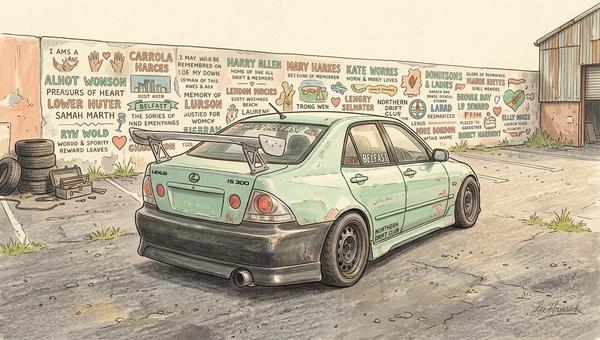
Bodywork received equally dramatic treatment. Sharply extended front spoilers, sometimes called shakotan (slammed) front lips, were paired with massively flared fenders that pushed far beyond the factory wheel arch. Enormous rear wings, more theatrical than aerodynamic, rose from trunk lids at angles that would have horrified any wind tunnel engineer. The goal was visual mass and implied aggression, not downforce.
Ride height was dropped aggressively — shakotan builds could sit only centimeters from the road surface. This wasn't about improved handling; it was about attitude. A car riding that close to the ground projects a specific kind of menace.
Paint and graphics completed the picture. Deep metallic colors, kanji script, rising sun motifs, intricate pin-striping, and occasionally hand-painted murals covered these cars. The visual language borrowed from yakuza aesthetics, traditional Japanese imagery, and American custom car culture in roughly equal measure.
The Machines Themselves
While bosozoku culture applied its aesthetic to a wide range of Japanese cars, certain platforms became particularly associated with the movement. The Nissan Skyline C10 and C110 generations, the Toyota Celica TA22 and TA27, the Mazda Cosmo, and various Mitsubishi and Honda coupes of the 1970s were common starting points. On the motorcycle side, Kawasaki's Z-series, particularly the Z400 and Z750, were frequent canvases, along with Honda's CB range.
These weren't expensive exotics. Part of what defined bosozoku culture was accessibility — these were attainable cars that young people could buy cheaply and modify progressively, each addition a further statement of commitment to the subculture and distance from the mainstream.
The Decline and What Remained
Japan's government responded to bosozoku activity with increasingly strict traffic enforcement through the 1990s and 2000s. The Road Traffic Act amendments gave police broader powers to crack down on the group rides and street gatherings that were central to the culture. Membership, which had reportedly peaked at around 42,000 nationally in 1982 according to National Police Agency records, fell sharply through the following decades.
But the visual language bosozoku developed didn't disappear — it migrated. The stretched bodywork and dramatic exhaust treatments influenced Japanese domestic market (JDM) car culture broadly. The cars themselves became collectibles. Builders like Mikami Auto in Osaka kept the fabrication tradition alive, producing period-correct restorations and new builds for clients who wanted the aesthetic without the police pursuit.
Today, shows like the Nostalgic 2 Days event in Yokohama regularly feature bosozoku-influenced builds alongside more conventional classic Japanese iron. The style has also traveled internationally, appearing in builds across Europe, North America, and Australia — proof that the visual argument these cars made in 1970s Japan translated across cultural contexts.
Key Takeaways
- Bosozoku culture emerged in postwar Japan from working-class youth excluded from the country's economic boom, using extreme car modification as a form of public self-assertion.
- Signature modifications included takeyari exhaust pipes, sharply extended front spoilers, massively flared fenders, aggressive ride height drops, and elaborate paintwork — all prioritizing presence over performance.
- Common platforms included the Nissan Skyline C10/C110, Toyota Celica TA22/TA27, and Kawasaki Z-series motorcycles.
- Government crackdowns from the 1990s onward reduced active bosozoku groups significantly from the 1982 peak of approximately 42,000 members.
- The visual language survived its original context, influencing global JDM culture and appearing in collector car events and international builds decades after the movement's peak.

Written by
Tom Kubo