The C8 Corvette Is the Best Supercar Deal on Earth and It's Not Even Close

The mid-engine C8 Corvette hits 60 mph in 3.0 seconds and tops 194 mph for a fraction of what Ferrari charges. Here's what that means for enthusiasts.
Let me tell you what it feels like to pull into a track day grid in a C8 Corvette and watch a guy climb out of a 911 Carrera S do the math in his head. He paid somewhere north of $130,000. You paid roughly half that. You ran under 3.0 seconds to 60 mph on the way in. The mid-engine switch didn't just make the Corvette faster. It made it embarrassing to own anything else at this price point, and the numbers back that up completely.
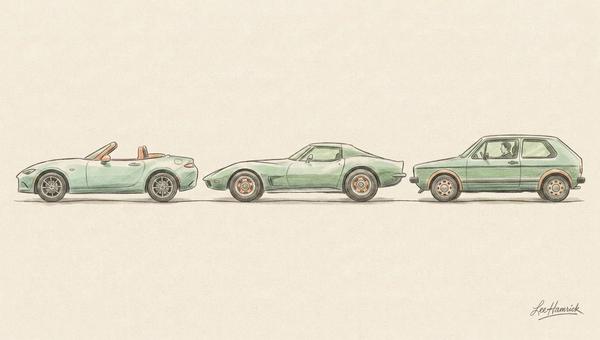
For seven generations and nearly seven decades, the Corvette wore its front-engine layout like a badge of American identity. Then, in 2020, Chevrolet moved the engine behind the driver for the first time in the nameplate's history, a decision the engineering team had reportedly studied since the 1960s. That one change reframed what the Corvette is. It's not America's sports car anymore in the nostalgic, apologetic sense. It's a legitimate supercar that happens to have a Chevy badge and a base price that undercuts almost every European competitor it humiliates on track.
Why the Layout Change Actually Matters
The mid-engine configuration isn't a gimmick or a marketing pivot. Moving the mass of a V8 closer to the car's center lowers the polar moment of inertia, which means the car resists rotation less and responds faster to steering inputs. Ferrari, McLaren, and Lamborghini have built their entire performance cases around this principle for decades. The C8 is Chevrolet's answer to that argument, and it arrives with genuine engineering credibility rather than showroom posturing.
On a track, those physics show up in transition speed, which is how quickly the car rotates when flicking from one corner to the next. Chevrolet's own testing at Virginia International Raceway put the C8 at a 2:37.3 lap time, a benchmark they used to demonstrate the chassis balance the new layout provides. Understeer, which is a common criticism of heavier front-engine sports cars pushed hard through a corner, is significantly reduced. The car goes where you point it, not where momentum argues it should go.
For road driving, the low seating position and the absence of a long hood stretching out ahead of you improve forward visibility in a way the C7's proportions never could. The trade-off is reduced rear visibility, partly managed by the standard rear camera system.
The Engine and What the Numbers Actually Mean
The naturally aspirated 6.2-liter LT2 V8 produces 490 horsepower and 465 lb-ft of torque in standard trim. Power routes through an eight-speed dual-clutch transmission, the Corvette's first DCT, mounted at the rear axle in a transaxle arrangement that further balances front-to-rear weight distribution. This is not an afterthought powertrain bolted into a new body. The entire drivetrain layout was rearchitected to make the car handle, not just go fast in a straight line.
The Z51 Performance Package pushes output to 495 horsepower and 470 lb-ft of torque through revised engine calibration, an improved cooling system, an electronic limited-slip differential, and performance exhaust. It also adds larger Brembo brakes and a more aggressive suspension tune. The 3.0-second 0-60 mph time is a Z51 number. The top speed of 194 mph puts it directly against the Porsche 911 Carrera S, which tops out at 191 mph, and costs significantly more to take home.
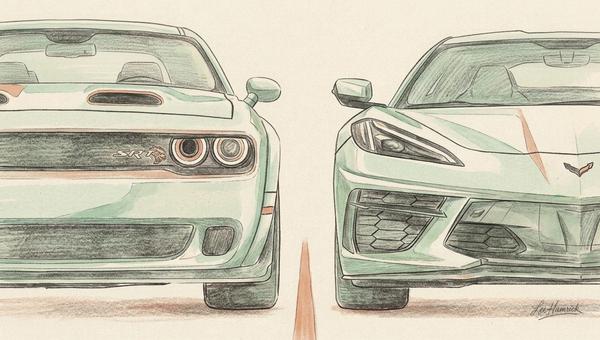
I ran the comparison. The Carrera S makes 473 horsepower in base trim. The Z51 C8 makes 495. The Porsche costs more. The Corvette wins on power, wins on price, and matches or beats it everywhere a lap timer cares about. People want to debate this like it's close. It is not close.
What You Actually Get Inside
Previous Corvette generations carried a justified reputation for interiors that didn't match the car's performance credibility. Cheap plastics, uninspired layouts, the sense that GM spent the budget where it mattered and called it a day everywhere else. The C8 addresses this directly.
The cabin is built around the driver, with the center console angled toward the seat and a row of toggle switches lifted from fighter-jet aesthetics. The instrument cluster is a 12-inch fully digital display, configurable across multiple driving modes. Infotainment runs through an 8-inch touchscreen that supports Apple CarPlay and Android Auto, with a standard Bose audio system. Leather seats and a leather-wrapped steering wheel are standard. It's a meaningful step up, and it matters because it removes the last excuse anyone had for choosing a European competitor on quality grounds.
The C8 also comes equipped with forward collision warning, lane keep assist, and adaptive cruise control. These broaden its usability as a daily driver without diluting the performance focus. If you want to drive it to work on Tuesday and to a track day on Saturday, the car supports both without asking you to compromise.
The Verdict, By the Numbers
- The mid-engine layout delivers measurably faster steering response, reduced understeer, and a weight balance that rewards both track and road driving. This is what Ferrari charges six figures to give you.
- The standard LT2 V8 produces 490 hp and 465 lb-ft of torque. The Z51 package lifts those figures to 495 hp and 470 lb-ft with upgraded brakes, suspension, cooling, and an eLSD.
- A 3.0-second 0-60 mph time and 194 mph top speed place the C8 alongside European competitors that cost dramatically more. The Porsche 911 Carrera S tops out at 191 mph and makes 473 hp. The math is not complicated.
- The interior takes a meaningful step forward in quality, pairing a 12-inch digital cluster and 8-inch touchscreen with leather trim and Bose audio as standard equipment.
- The C8 is the first mid-engine Corvette in production history. That layout change isn't a footnote. It's the reason this car competes with machinery that costs twice as much and wins.
What the mid-engine switch actually changed is the conversation. You used to buy a Corvette because you wanted American performance value and were willing to accept that it wasn't quite the same thing as a European sports car. Now you buy a C8 because the data says you'd be overpaying for anything else. That's not a small shift. That's the whole ballgame.

Written by
Ben Eckels