The McMurtry Spéirling Pure Is a $1.3 Million Track Weapon That Pulls 3 Gs and Doesn't Need a Pit Crew

The production McMurtry Spéirling Pure makes 1,000 hp, hits 60 mph in 1.55 seconds, and generates 4,400 lbs of downforce from a standstill. Here's what it is.
Look, I'm just going to say it: the McMurtry Spéirling Pure is the most legitimately insane thing you can write a check for and drive yourself. Not the fastest car in some hypothetical spec sheet war, not the most expensive piece of rolling art you park in a climate-controlled garage and photograph. A car you actually run at a track, by yourself, without a full race crew, that pulls three Gs in corners and hits 60 mph in 1.55 seconds. That number isn't a typo.
McMurtry's been building toward this for five years. Prototypes set records that made serious people do double-takes: fastest ever up the Goodwood hillclimb, a lap time around the Top Gear test track that beat a Renault R24 Formula 1 car. Those were prototypes. Now the production car is here, it's called the Spéirling Pure, and it's bigger, heavier, and somehow still jaw-dropping.
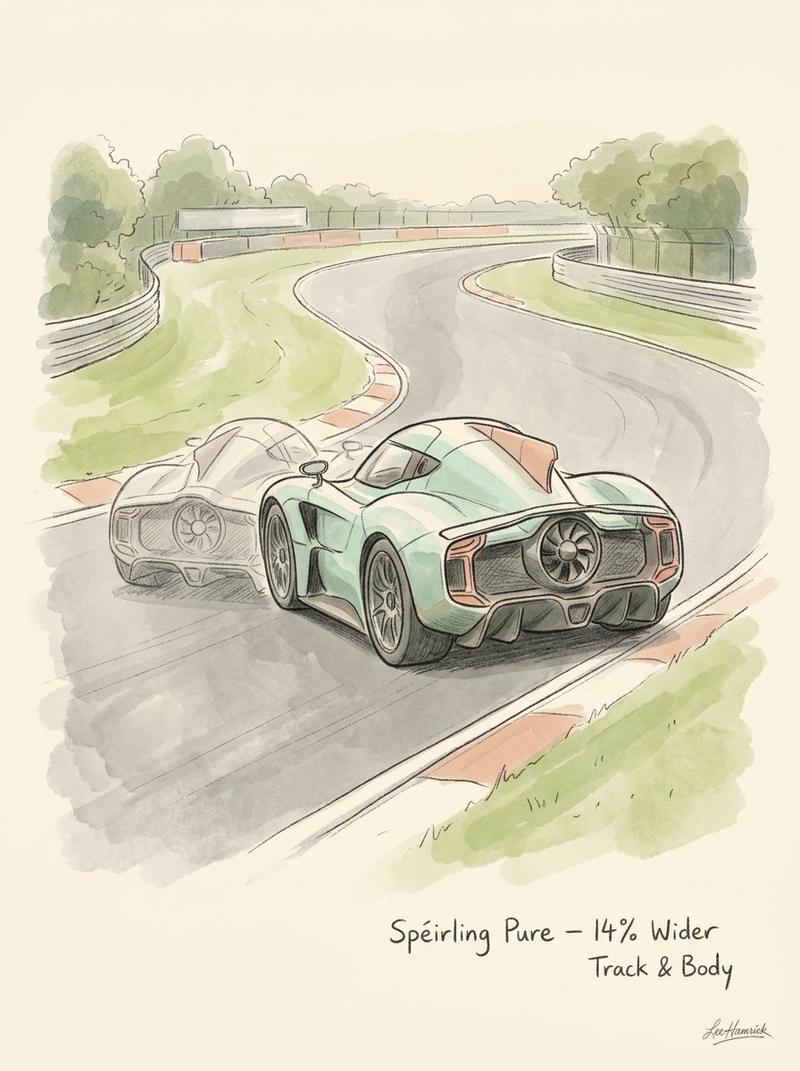
Bigger by 11 percent in length and 14 percent in width versus the prototype. That extra size is mostly in service of a much larger battery pack: 100 kWh in the Pure versus 60 kWh in the prototype. More energy means more runtime, and McMurtry rates the Pure at 40 to 50 kilometers of range at LMP2 pace. If you've watched any endurance racing, you know LMP2 cars don't putz around. That's a meaningful number for a track session.
More battery also means more weight, and the Pure pays for it. The production car carries about 660 additional pounds over the prototype. Before you write that off as disqualifying, here's the context: the prototype was absurdly light to begin with. End result is a production car that weighs only about 145 pounds more than a new Subaru BRZ. A Subaru BRZ. Making 1,000 horsepower. With a top speed of 190 mph. If that doesn't rearrange your brain a little, read it again.
The thing that makes all of this possible is the fan system, and it's as wild in production form as it ever was. Two fans spin at up to 23,000 RPM and evacuate air from underneath the car, generating up to 4,400 pounds of downforce from a complete standstill. Not at speed. Stationary. Zero mph. The car has been driven upside-down as a demonstration of what that downforce figure actually means in physics terms. Three Gs of peak cornering and braking force puts it in Le Mans Hypercar territory, which is a sentence I didn't expect to type about something road-registered people can buy.
McMurtry also made real usability improvements for the production version, which matters when your customers are wealthy enthusiasts rather than contracted factory drivers. The new carbon fiber monocoque meets motorsport safety standards and is built around actual human beings: door aperture is wider, revised A-pillars cut blind spots, and the car will fit drivers up to six-foot-seven. Air conditioning is available as an option, which sounds funny until you're sitting in a sealed composite pod on a track that's baking at 100-plus degrees.
Suspension got smarter too. Ride height is up 20 percent from the prototype, articulation is increased, and higher-profile tires mean the Pure handles bumpy track surfaces and curbing without jarring your skeleton loose. The steering has been swapped from electric power assist to an electrohydraulic setup specifically for better feedback. That's the right call, and it signals McMurtry understands what enthusiast drivers actually want from a machine at this level.
Here's where the value argument gets interesting, even at $1.3 million. Most prototype-class cars require a full race crew just to operate between sessions: engine rebuilds, clutch replacements, specialized warm-up equipment, the works. McMurtry says the Spéirling Pure needs a driver and one competent friend. That's it. No engine rebuilds because there's no engine. No clutch because there's no clutch. The tires are Michelin S8M slicks that run $800 to $900 each, which is real money, but it's not exotic-prototype money.
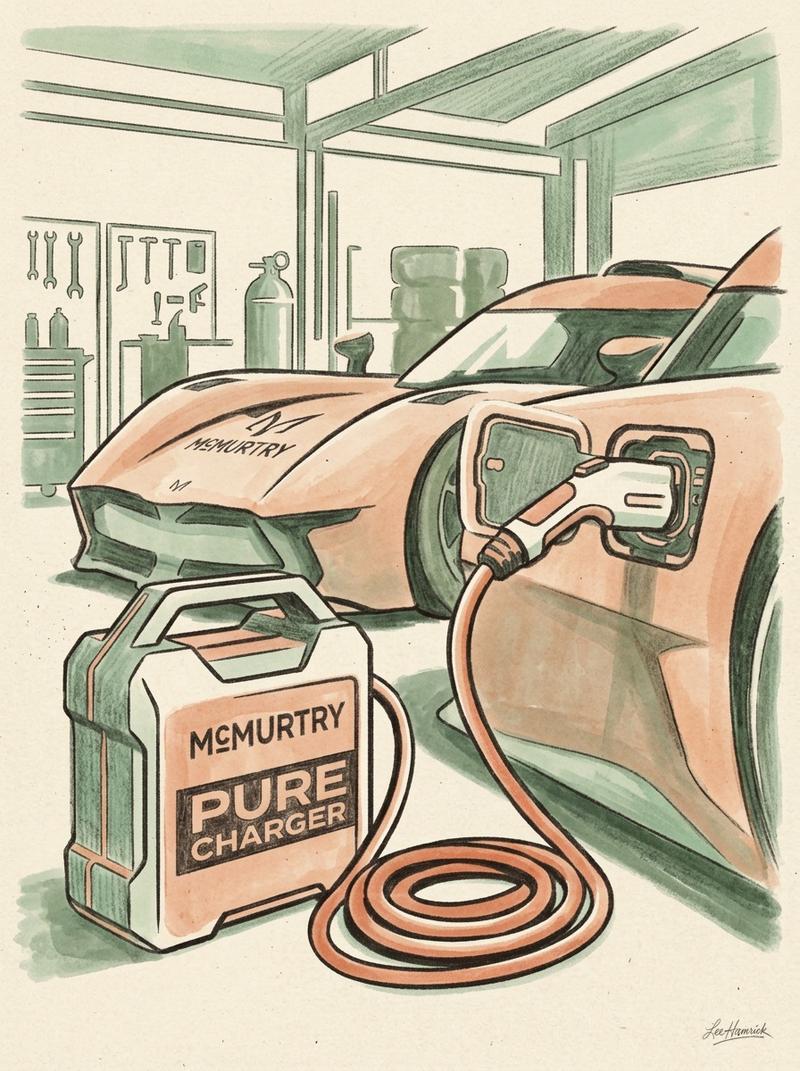
The charging situation is also solved. Since most track facilities don't have DC fast chargers sitting in pit lane, McMurtry built a dedicated power bank: 100 kWh capacity, 120 kW output, plugs into a standard wall connection, and should have the car back to full charge in under an hour. That's an accessory they had to invent from scratch, and the fact that they did it tells you this is engineered for actual use, not just a press release.
Fan cars have existed before. The concept isn't new. But nothing at this performance level has ever been available for private purchase at a track day, and the Spéirling Pure is time attack-eligible on top of everything else. The question of who runs one first at Global Time Attack or Time Attack Masters is genuinely exciting. Public debut is scheduled for The Quail in Monterey later this summer, with deliveries starting later this year.
I don't care if this is controversial: $1.3 million for a 1,000-hp, fan-assisted, 1.55-second-to-60 time attack weapon you can run with one friend is not an unreasonable proposition. Compared to what it takes to campaign a proper prototype, it might even be the smart play. The Spéirling Pure isn't just fast. It's fast in a way that makes everything else look like it's standing still, because according to that fan system, it basically is.

Written by
Vince Russell