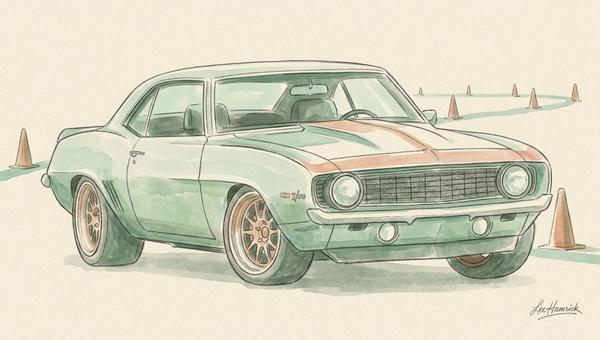
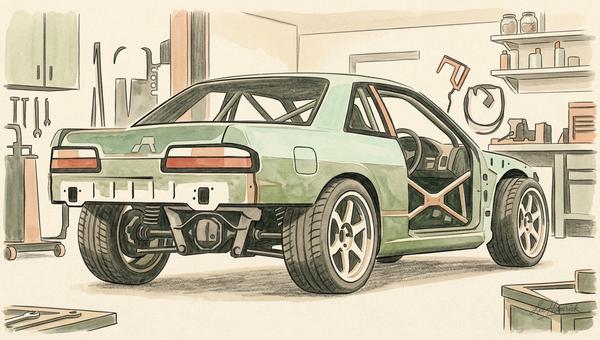
How to Build the Best Budget Track Car: A $2,500 Project Done Right

Building a capable track day car on a tight budget is possible. Here's how to find the right platform, prioritize the right mods, and actually get on track.
Let me tell you a story about a guy standing in a gravel lot somewhere between a salvage yard and a dream, staring at a car that most people would walk right past. The paint is tired. One of the wheels has a scrape that tells a story nobody wrote down. The seller is talking about how it runs great, which, as we all know, is the universal signal to look harder at the engine bay. And yet. Something about the proportions, the weight sitting low on its suspension, the way the nose points at you like it's asking a question, you know this is the one.
Budget track builds have this funny reputation. People hear "project car" and picture a money pit, a garage queen, a machine that generates invoices instead of lap times. And sure, plenty of them turn out that way. But when the platform is right and the priorities are right, a car you bought for under three thousand dollars can do things on a track that would embarrass cars costing ten times as much. The key is knowing the difference between a car that's cheap and a car that's good value. Those are not the same thing at all.
The platform is everything. Before you buy one bolt, one set of pads, one alignment appointment, you need a car that wants to be driven hard. A front-wheel-drive econobox can absolutely be a track car, but you're fighting the layout from the first lap. A heavy cruiser with a big engine is a different kind of fight. What you want, especially at this price point, is something light, balanced, and already designed with the driving experience in mind. In the US market, that conversation usually starts with a few well-known names: the Mazda Miata in its NA or NB form, the early Honda S2000, a late-nineties BMW E36 or E46, or a first-generation Subaru BRZ if you can find one in budget. All of these cars share something important: the engineers who designed them were at least a little bit enthusiastic about how the car would feel at the limit, not just how it would score in a parking lot evaluation.
The Miata deserves its own sentence because it almost always deserves its own sentence. A clean NA or NB Miata under $3,000 is not a fantasy. It exists. It is out there right now on Craigslist, Facebook Marketplace, and AutoTrader, usually listed by someone who bought it thinking they'd restore it and then ran out of weekends. These cars are light (right around 2,300 pounds), balanced front to rear, and have been the backbone of club racing in this country for thirty years for a reason. When the budget is the constraint, the Miata makes the math work.
Once you have the right car, the temptation is to go straight for power. Resist it. At a track day, particularly in the early sessions, power is not what's holding you back. What's holding you back is tires, brakes, and your own inputs. A hundred-horsepower car on good tires will feel faster and be faster than a two-hundred-horsepower car on worn all-seasons with stock brake pads that are already fading by the third lap. Every experienced HPDE instructor will tell you this, and most students nod and then go home and look up intake kits anyway. Don't be that student.
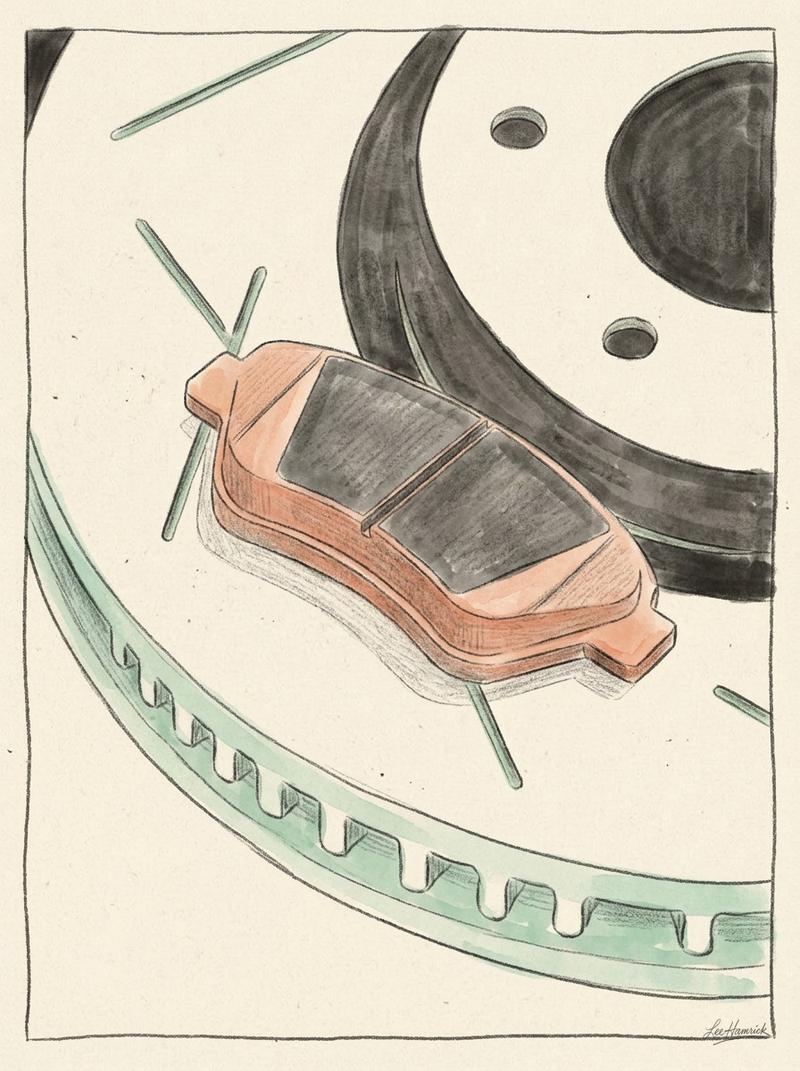
Start with the brakes. This is where the DBA Street Series T2 slotted rotors come in, and pairing them front and rear with a performance pad like Hawk's DTC-60 up front is a combination that's proven itself on track cars in exactly this budget range. The T2 rotor's slotted face helps with pad deglazing and gas evacuation under hard use. The DTC-60 is a legitimate track compound, aggressive enough to give you real bite when the temperatures are up, while a milder rear pad keeps your bias sensible so you're not locking the rears under trail braking. This is not an exotic setup. It's not expensive. But it's the difference between a car that fades on lap four and one that stops consistently all day.
After brakes, tires. A used set of sticky summer performance tires on a second set of wheels is the single largest lap time improvement available at any price. We're talking about moving from a 200 treadwear all-season to something like a 200 treadwear performance summer tire, or better yet a dedicated track tire like the Falken RT660 or Michelin Pilot Sport Cup 2. The difference in cornering grip is not subtle. It doesn't show up as a slight improvement in lap time. It shows up as a fundamental change in what the car can do in a corner, how early you can get back to throttle, how confidently you can trail the brake through the apex. If you have $500 left in the budget after the car and the brakes, spend it on a second set of wheels and whatever sticky tire fits your budget.
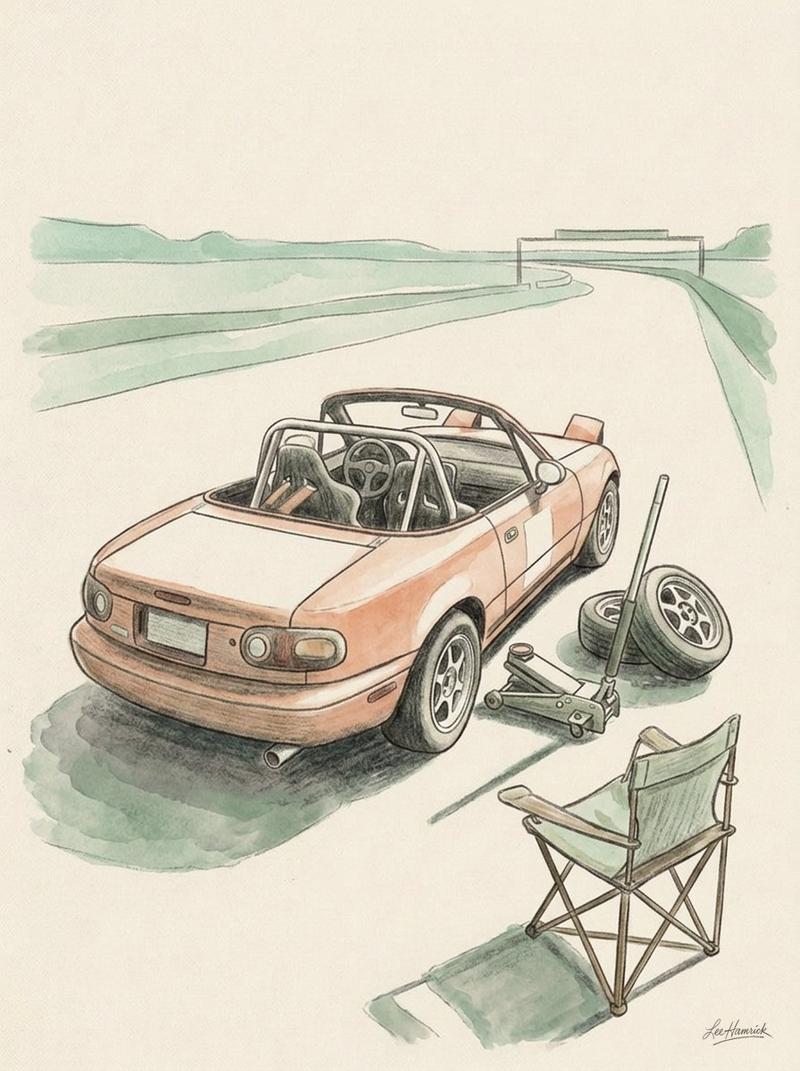
Suspension comes next, but here's where I'd pump the brakes (no pun intended) on the impulse to spend money. On most of these budget platforms, the factory suspension geometry is not the problem. Worn bushings, shot shocks, and misaligned corners are the problem. A front-to-rear alignment with camber adjusted toward negative one to negative one-and-a-half degrees in front will transform the car's cornering behavior for about $150 at a shop that knows what they're doing. Replace worn shocks and struts before you ever consider a coilover kit. A fresh set of KYB Gas-a-Just shocks on a tired Miata will feel like a different car. The coilover conversation can come later, after you've driven the car enough to know what you actually want to change.
The last thing, and it costs nothing, is seat time with intention. Not lapping. Not going fast. Seat time with a specific focus on one corner, one braking zone, one turn-in point. This is what separates drivers who get faster from drivers who just get more comfortable going the same speed. Pick the corner that scares you. Work it. Ask your run group instructor to ride with you through it. The car will tell you things when you're focused that it never tells you when you're just driving.
A well-chosen platform, proper brakes, a sticky tire, and a suspension that's actually set up for the work. That's the whole recipe. You haven't lived until you've felt a properly sorted Miata rotate on throttle at the exit of a sweeper, light as a thought, pointed exactly where you asked it to go. And when you built the thing yourself, when you know every part on it and why it's there, that feeling is something else entirely. Trust me on this one.

Written by
Joshua Hawkins