What One Designer Learned Selling on Blipshift: The Real Economics of a T-Shirt
A Blipshift artist breaks down the real economics of selling a car t-shirt design: commissions, marketing lessons, and what actually moves shirts.
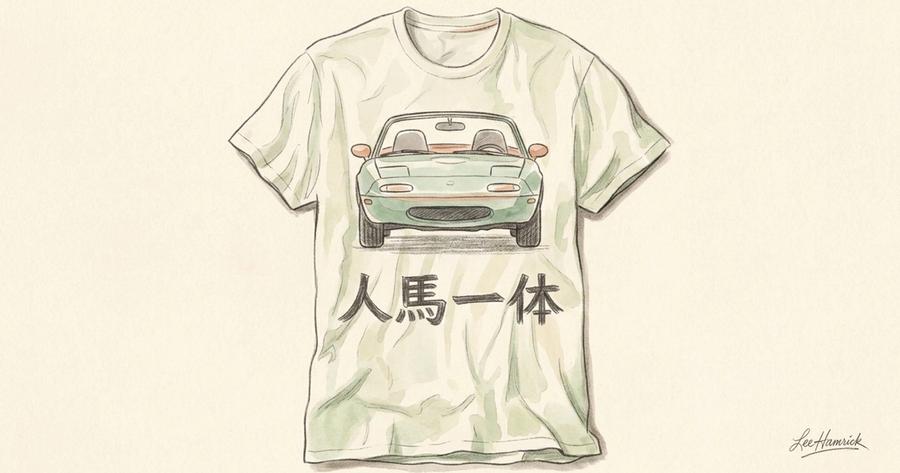
The phrase was jinba ittai, "horse and rider as one," Mazda's entire philosophy for the MX-5. For anyone who has spent real time behind the wheel of an NA, the concept either clicks immediately or it doesn't. The first time it clicked for this writer was mid-corner on a back road, the kind of moment where the car stops being a machine and starts being an extension of the decision you just made, and the Japanese characters Mazda put to it suddenly felt less like marketing and more like a technical specification. That experience is where the idea for a shirt was born: an NA roadster, front-on, distressed just enough to feel like mid-century Japanese advertising, with those four characters underneath. Clean. Honest. Not trying to be clever.
The design went to Blipshift. Then the designer, who asked to remain identified only by their ZealAuto handle, waited.
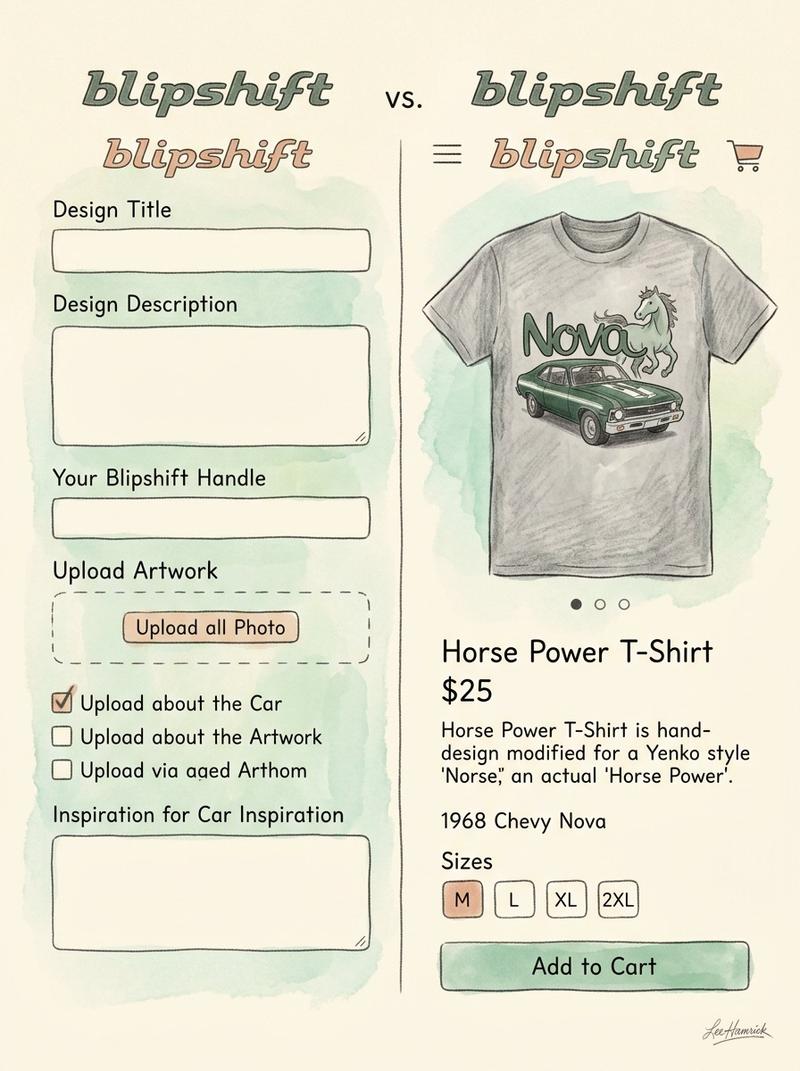
If you've spent any time in this hobby, you already know Blipshift. Founded in 2012, the company has built a catalog of more than 1,300 designs and a following of over 100,000 across social media, all on a simple model: new tee designs available every day, and you have 48 hours to buy one after it first appears. The archive is enormous and the designs come from the community, which means, theoretically, from people like you and me. In practice, most submissions probably die in an inbox. This one didn't, which is where the story actually starts.
The email that changed the trajectory
Mid-August, a contact at Blipshift wrote to say the design had been picked up. It would go live the following Wednesday under a title the Blipshift team landed on themselves: "Horse Power." The submission had gone in with just the characters and the car, no pun intended. Somewhere in their shop, someone looked at "horse and rider as one" and found the English version hiding inside it. The designer's account of receiving that email is straightforward: it was better than what they'd come up with, and they got to take no credit for it.
Blipshift needed the usual things: shirt size, shipping address, a bio, any links to plug. The design went live. On the product page, the submitter appeared as a featured artist.
Where the marketing brain took over
Blipshift encourages what they call "shameless self-promotion." The designer went further, running a paid search campaign aimed largely at impressions outside the US and Canada, betting on cheaper clicks and a positive return. The flaw in that plan revealed itself when Blipshift shared their numbers afterward: the overwhelming majority of buyers turned out to be domestic. The campaign had spent money to reach markets that don't buy Blipshift shirts.
There was no visibility into what happened on the other side of the landing page, so whether that traffic bounced immediately or browsed for a while is unknown. The demographic reach extended into markets where a Mazda roadster shirt is a hard sell regardless of price. More questions than answers.
Lesson one, free of charge: the organic posting Blipshift recommends, reaching out to people who already care about that specific car, almost certainly moved more shirts per dollar than any paid campaign could manage without conversion data on the other side.
The numbers that matter
The run sold 360 shirts.
The designer asked how good that actually was, having nothing to compare it to. Blipshift's artist FAQ is clear about one number: artists receive a guaranteed minimum payment of $250 at $1 per shirt, meaning Blipshift commits to paying at least $250 even if sales fall short of that. What the average run actually sells is not published. What is published is the commission structure: $1 per unit on a homologation run, plus a copy of the shirt. So 360 shirts came out to a $360 check and a W9. Blipshift paid on schedule.
For context on the partner store side of the business, the math is different. On a standard Next Level Fitted Tee retailing at $20, the artist earns $6 per unit. On a Gildan Hoodie at $40, same $6. The commission is flat across the product line regardless of base cost, which makes the economics straightforward if not generous. A back print adds $2 per unit to the base cost, which comes out of that margin.
This is the honest part: you do not do this for the money. You do it because somewhere out there, a stranger you'll never meet paid actual dollars to wear an idea you put on paper. That trade is wildly in your favor even at a dollar a shirt.
Then they asked for something else entirely
Four years later, in 2022, Blipshift reached back out. They were building an ambassador program and wanted the designer in it. The reason they gave: design history plus community presence, the kind that shows up in person at track days and cars and coffee, not just online.
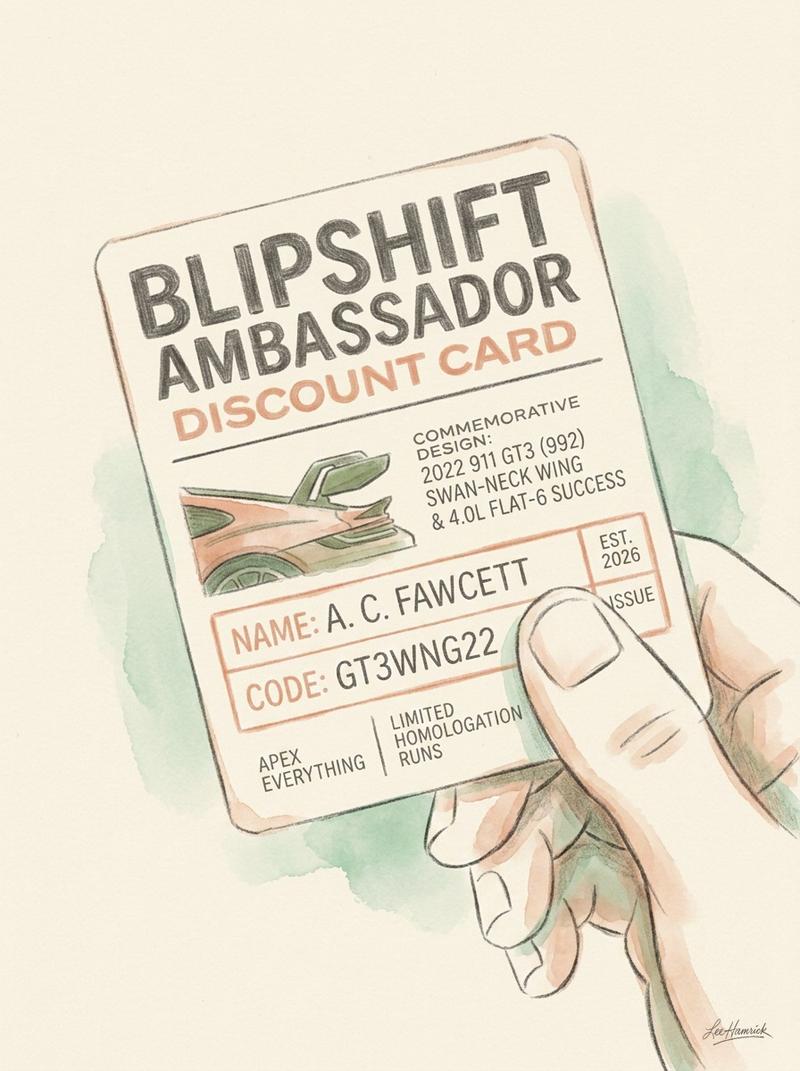
Ambassadors receive swag and discounts. The public-facing mechanic involves unique discount cards distributed at events: new customers get money off a first order, and the code lets Blipshift attribute which paddock conversations actually turned into sales. Face-to-face word of mouth, tracked. For anyone who thinks about marketing for a living, watching a brand wire attribution to a guy talking shop in a parking lot is a genuinely elegant piece of engineering. What else ambassadors receive beyond the discount cards and swag is not spelled out in Blipshift's public materials.
They asked what handle to print on the card. The designer gave them the one attached to this site.
What happens when the tail keeps moving
Five years after the first launch, in the fall of 2023, Blipshift brought the design back for another run. Same dollar-per-unit deal, still flowing to the designer years after the original work was done. That re-release moved another 104 shirts. Not fireworks. Found money for a design made once and never touched again.
Add it up and that one idea has sold 464 shirts across two runs and six years. Not a fortune. A story.
The one that got away
Every shop story has a loose thread. This one involves a second design, conceived around wanting a darker shirt as the canvas, started and never finished. It is still sitting in a folder, good and incomplete, in the great tradition of personal projects everywhere.
Which is, if you're being honest about this hobby, the most accurate thing in the whole account. You build the thing, you love the thing, and sometimes the thing just sits there being good and not done.
If you're thinking about hitting Submit
Blipshift does not accept AI-generated imagery or AI-generated source files. Submissions should be layered raster/vector files with each color on a separate layer, sized to a maximum of 12.5 by 14 inches at 300 dpi, and using six spot colors or fewer not counting the shirt color. The submission itself goes in as a flattened JPG or PNG. If the design is accepted for a homologation run, you get $1 per shirt, a guaranteed minimum payment of $250, and a copy of the shirt. Blipshift makes no guarantee of sales volume beyond that minimum payment. Either party can end the agreement with 14 days' written notice, and while the agreement is active, you cannot sell the design on apparel or posters elsewhere.
A few things the designer would actually tell you, distilled from the experience above.
The concept does the heavy lifting. This worked because the idea was already true about the car. Jinba ittai is a real thing you feel in an NA before you know there's a word for it, and the design just pointed at that and got out of the way. Find the thing your favorite car already is and say it plainly.
Promote like a human, not like a media buyer. Post it to the people who already love that car. The paid-traffic receipts exist to prove the boring advice is the right advice.
Expect a badge, not a paycheck. A dollar a unit on a homologation run is the deal. Make peace with that before you start and the whole thing is pure upside.
The tail is real, and it can branch. A design can come back years later and pay again, and it can open doors you didn't apply for. One shirt turned into an ambassador invite four years on.
One design, submitted once, went up for sale twice, sold 464 shirts to strangers, and is still sitting in the catalog. For a hobby that mostly takes your money, that's a reasonable return.

Written by
Lee Hamrick